
Kudeejeen is a 250-year-old multicultural community on the banks of the Chao Phraya River in the Thonburi district, Bangkok. The neighborhood was established in 1767 after the fall of Ayutthaya when King Taksin granted land to Portuguese settlers. You can reach this Bangkok neighborhood by Chao Phraya Express boat to Memorial Bridge pier, then walk 10 minutes through narrow streets lined with wooden houses. At GEOS, our field trips take ED visa students to neighborhoods like Kudeejeen with Thai teachers. We’ve maintained MOE recognition for 20+ years with 1000+ graduates and 100% approval rates for complete applications. Our cultural program helps students understand Thai history while practicing conversational Thai in real situations. Here’s what you need to know about visiting this Thai-Portuguese community in Bangkok.
Kudeejeen (also spelled Kudichin) means “church neighborhood” in Portuguese. The area sits peacefully between Buddhist temples, a Chinese temple, and Santa Cruz Church. This small village survived Bangkok’s modernization because residents value cultural heritage over commercial development.
Walk down narrow streets, and you’ll see Thais, Portuguese descendants, and Chinese families living harmoniously. Buddhist monks pass Santa Cruz Church daily. The smell of fresh khanom (Thai sweets) from Thanusingha Bakery House fills the air.
Most tourists rush to the Grand Palace and Wat Pho in Bangkok. ED visa students at GEOS visit the Kudeejeen community with Thai teachers to practice language skills while learning Thai-Portuguese history.
Take the Chao Phraya Express boat to Memorial Bridge (Saphan Phut) pier. Exit toward Thonburi district and walk 10 minutes west. The neighborhood is walkable and compact.
You can also take the MRT to Sanam Chai station, then grab a taxi across the river. The BTS Silom Line stops at Wongwian Yai in Thonburi, though you’ll need a taxi or motorcycle taxi from there.
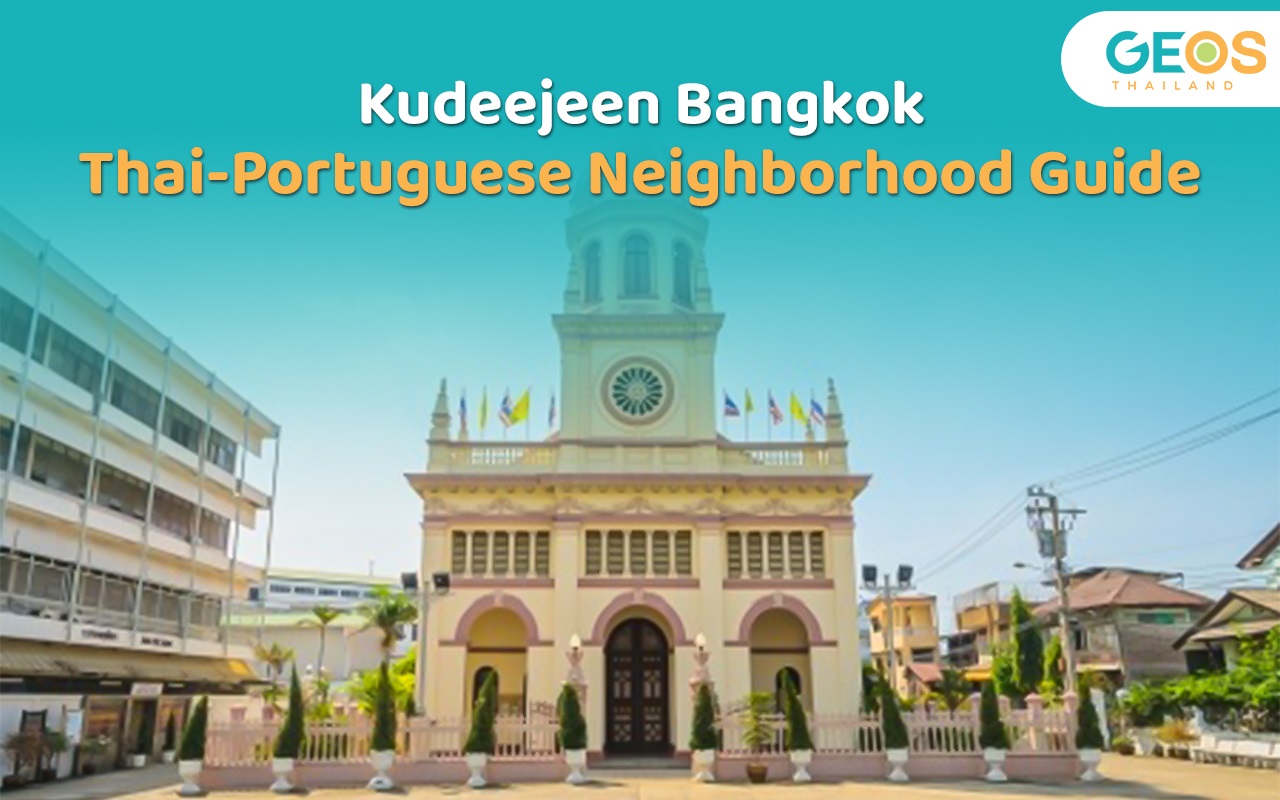
The Portuguese community area centers around Santa Cruz Church, built 250 years ago. Use the church’s white facade as your landmark.
Santa Cruz Church was built in 1770 after King Taksin granted land to Portuguese Catholics who had served during the fall of Ayutthaya. The current structure was constructed between 1913-1916 to replace the original wooden structure, but the interior preserves elements of the 1770 design. Mass is held in the Thai language throughout the week.
Thanusingha Bakery House makes khanom farang, a famous treat made from a recipe dating back 200 years. The raisin-filled pastry blends Portuguese and Thai baking techniques. Lines form early each morning.
Kuan An Keng Shrine is a small Chinese temple near the church. Buddhists and Christians share the same narrow street. This peaceful coexistence defines the multicultural community.
Baan Kudichin Museum is a small museum inside a traditional wooden house. Volunteers explain Thai-Portuguese history and show photos from the 1950s. Entry is free, donations appreciated.
Most Bangkok language schools keep students in classrooms. GEOS’s field trips give ED visa students real language practice in neighborhoods throughout Bangkok.
Students practice:
This cultural immersion is what Thailand’s Ministry of Education expects from genuine language schools. According to the Thai Immigration Bureau, students must demonstrate educational intent when applying for visa extensions. Our 4-level Thai program combines classroom learning with cultural experiences in Bangkok. Students can start any week since we use open-book levels.
The Thai Ministry of Education requires language schools to provide structured curricula. GEOS’s field trips supplement classroom learning with real-world practice, not tourist excursions.
Yes. The neighborhood welcomes visitors daily. Santa Cruz Church opens for tours between 9:00 AM and 4:00 PM. Thanusingha Bakery House sells out by noon on weekends.
Walking tours start at the Memorial Bridge pier. Budget 2-3 hours to explore the narrow streets, visit the Buddhist temple, and try street food near the Portuguese community area.
However, visiting with Thai teachers helps you understand the cultural context. You’ll learn why Portuguese settlers came to Bangkok 250 years ago after Ayutthaya fell, why King Taksin established Thonburi as Siam’s new capital, and how the capital of the kingdom eventually moved across the river to Bangkok in 1782.
Kudeejeen is pronounced “koo-dee-jeen” in Thai. Some maps spell it Kudichin or Kudi Chin, but locals use Kudeejeen. The name comes from Portuguese “igreja,” meaning church, combined with Thai pronunciation patterns.
Visit between 8:00 AM and 11:00 AM on weekdays. Thanusingha Bakery House sells out by noon. Santa Cruz Church opens at 9:00 AM. Early morning avoids crowds and gives you time to explore the narrow streets before the afternoon heat.
The BTS Silom Line reaches Thonburi at Wongwian Yai station, but you’ll need a taxi or motorcycle taxi from there. The Chao Phraya Express boat to Memorial Bridge pier is more convenient and costs 15-20 THB with better river views.
Yes. GEOS takes ED visa students on field trips for real Thai language practice with cultural context. This genuine education approach is what Thailand’s Ministry of Education expects from MOE-recognized schools.
Try khanom farang, the famous raisin pastry made from a recipe dating back 200 years. It’s a Portuguese-Thai fusion treat unique to this neighborhood. Order in Thai to practice: “Khor khanom farang neung thoong” (ขอขนมฝรั่งหนึ่งถุง).
Plan 2-3 hours to visit Santa Cruz Church, Thanusingha Bakery House, Kuan An Keng Chinese temple, and the small museum. The neighborhood is compact and walkable. Add an hour if you want to explore street food near the banks of the Chao Phraya River.
Chinese residents lived peacefully together 250 years ago. Santa Cruz Church sits near a Buddhist temple and a Chinese temple on the same narrow street. This harmonious coexistence makes it unique in Bangkok.
At GEOS, we don’t just teach Thai in classrooms. Our field trips take ED visa students to neighborhoods throughout Bangkok with Thai teachers. You’ll practice conversational Thai while learning about cultural heritage, street food, and Thai-Portuguese history.
We’ve maintained MOE recognition for 20+ years with 1000+ graduates and 100% approval rates for complete applications. We accompany students to their first Immigration appointment for ED visa approval. Our 4-level Thai program runs for 14 months. Pay per term (25,000 THB + 13,500 THB + 16,500 THB). Contact GEOS today to learn more about our ED visa program.
Explore our collection of captivating articles, each offering a unique perspective
GEOS Thailand is conveniently located in the heart of Bangkok, close to Asoke BTS and Sukhumvit MRT stations.
enquiry@geosthai.com