

Thai grammar is simpler than English in several key areas and harder in others. There are no verb conjugations, no gendered nouns, no plural forms, and no articles. The main challenges for English speakers are tones, which change word meaning entirely, and classifiers, which require different counting words for different noun categories. GEOS Thai teachers have over 10 years of experience teaching Thai to international students, and they see the same pattern consistently: beginners move faster than expected in the early weeks, then slow down when tones and classifiers arrive. This comparison covers the differences that actually matter for your progress.

No verb conjugation. In English, the verb changes depending on who is speaking and when. I run, she runs, they ran, we will run. In Thai, the verb never changes. You use the same form regardless of subject or tense. Context and time words carry that meaning instead.
No tenses in the traditional sense. Thai communicates time through words like already (laeo), not yet (yang), and yesterday (meua wan). The verb itself stays the same. “I eat” and “I ate” use the same verb. The time word tells you when.
No gendered nouns. French learners spend months memorizing whether a table is masculine or feminine. Thai has no such system. Nouns are just nouns.
No plural forms. In English, one cat becomes two cats. In Thai, the noun stays the same. You add a number or a quantity word, and the noun does not change. This removes an entire layer of memorization.
No articles. There is no Thai equivalent of “a” or “the.” The meaning is inferred from context. This feels strange at first, but students adjust quickly.
For English speakers, these absences make Thai feel significantly lighter than European languages in the early stages. Students in the GEOS Thai program consistently report that basic sentence construction feels approachable within the first few weeks.
Adjectives Come After Nouns
In English, you say a big house. In Thai, the adjective follows the noun: house big (baan yai). This applies consistently across Thai, so once you learn the pattern, you apply it everywhere. It feels unnatural at first and then becomes automatic.
Questions Are Formed Differently
English questions often require inverting the word order. “You are tired” becomes “Are you tired?” Thai keeps the word order the same and adds a question particle at the end. The most common is mai (ไหม), placed at the end of a statement to turn it into a yes/no question. “Khun nueay mai?” means “Are you tired?” The structure is literally “You tired?” with the question word at the end.
Classifiers
This is where Thai introduces a system English does not have at all. When counting nouns in Thai, you need a classifier, a category word that reflects the type of object you are counting. Animals use a different classifier from sheets of paper, which use a different one from long cylindrical objects, which use a different one from people.
Two dogs in Thai is not simply “two dog.” It is “dog two classifier-for-animals.” You need to learn which classifier goes with which category of noun.
This is the grammar point that takes the most time for English speakers to absorb. It is not difficult logically, but it requires consistent exposure and correction, which is one reason classroom study with a Thai teacher produces faster progress than self-study for this particular area. Building your core vocabulary alongside classifiers helps everything stick faster. Our basic Thai words and phrases guide covers the high-frequency words that come up most in early classroom study.
Topic-Comment Sentence Structure
Thai sometimes leads with the topic of the sentence before making a comment about it. “As for that restaurant, the food is good” is a more natural construction in Thai than the English version. You will hear this pattern in spoken Thai constantly. It takes time to produce naturally but is easy to understand once you recognize it.
Thai has five tones: mid, low, falling, high, and rising. As thai-language.com explains, the tone must be spoken correctly for the intended meaning of a word to be understood, which is why thai-language.com is a useful reference for beginners starting to work through the tonal system.
The word mai is the most famous example. It can mean new, wood, not, burn, or be a question particle, depending on the tone. A learner who has not absorbed the tonal system will produce sentences that are grammatically correct but tonally wrong, and the meaning will shift entirely.
Tones are not a grammar rule you can memorize in a weekend. They are a physical skill that develops through repetition and real-time correction. This is one of the clearest arguments for learning Thai in a structured classroom environment rather than through an app. A teacher hears your tone immediately and corrects it. An app either does not detect the error or flags it too late to build muscle memory.
At GEOS, our Thai teachers work with the direct method, which means you are producing spoken Thai from the very first class. Tone correction happens in real time, in context, during conversation. Students who study this way build tonal accuracy significantly faster than those who rely on written exercises alone. You can read more about how we structure the program by going straight to the GEOS Thai program page if you are ready to look at course details.
Thai is simpler than English in these areas: verb conjugation, noun gender, plural forms, articles, and basic sentence construction.
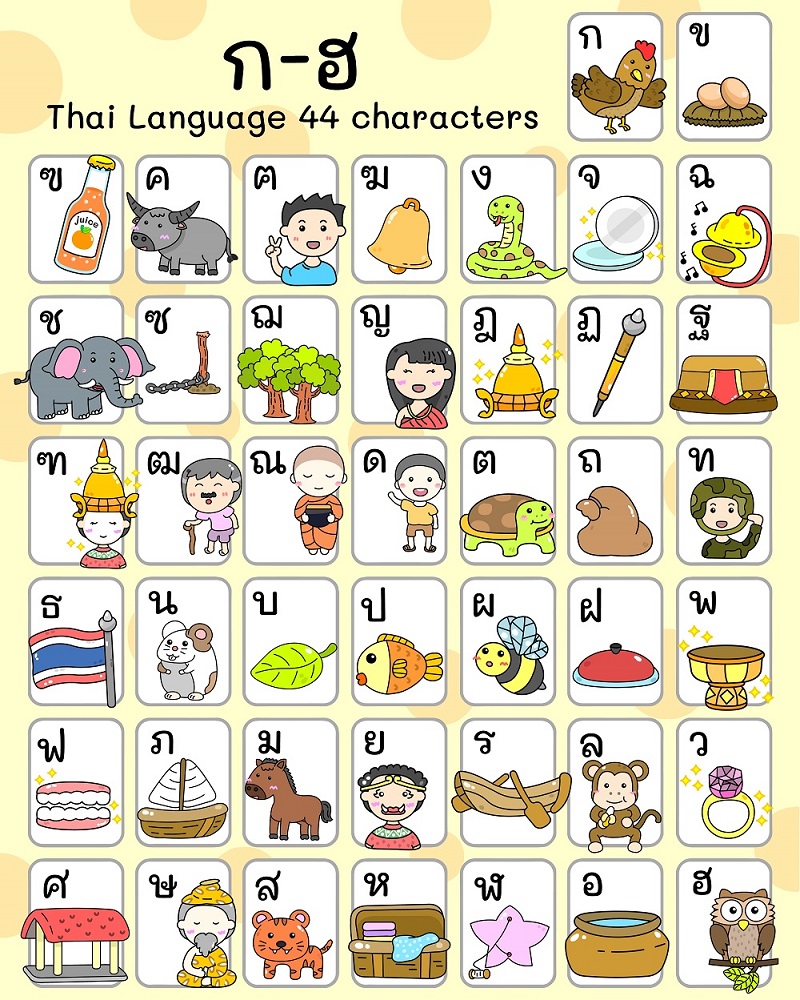
Thai is more complex than English in these areas: tones (five tones that change word meaning), classifiers (different counters for different noun categories), and the written script. Thai uses a completely different writing system with 44 consonants, vowel symbols, and tone markers. The Royal Society of Thailand is the official government body that governs Thai language standards and correct spelling.
The script deserves a brief mention here. Most beginners are advised to focus on spoken Thai first before tackling reading and writing. This is the approach GEOS uses in the early stages of the Thai program. The tonal system and spoken vocabulary are more immediately useful in daily Bangkok life, and reading progress comes faster once spoken fluency gives you a foundation.
The structure of Thai rewards a specific learning approach.
Because tones are everything and cannot be self-corrected reliably, you need a teacher who can hear you. Because classifiers require repeated exposure across many contexts, you need structured practice over time, not just a vocabulary list. Because the easy parts of Thai grammar really are easy, you can move fast in the early weeks and build confidence before the harder layers arrive.
This is why the GEOS Thai program is built the way it is: small group classes of no more than 12 students for ED visa students, direct method instruction, four levels across 14 months, with private lessons available for those who want to study without a long-term visa commitment. The program is designed around how Thai actually works, not how European language programs are structured.
If you are planning to study Thai long-term, the GEOS Thai program qualifies for an ED visa, which allows you to stay in Thailand legally for the full 14 months of the course. If you want to understand how the program is structured, contact us today and we will walk you through everything.
In some ways Thai is simpler: no verb conjugations, no gendered nouns, and no plural forms. The main challenges are tones, which change word meaning entirely, and classifiers, which require a different counting word for each category of noun. Most English speakers find the grammar logic easy to follow but need consistent practice to produce tones accurately.
No. Most learners focus on spoken Thai first and add reading and writing later. Spoken Thai is immediately useful in daily Bangkok life. Reading the script is a separate skill that develops faster once you have a spoken foundation. At GEOS, the Thai program introduces reading progressively rather than front-loading it.
Most students become comfortable with the most common classifiers within two to three months of regular study. There are hundreds of classifiers in Thai, but a core group of around 20 covers the vast majority of everyday situations. Classroom exposure with correction builds this faster than self-study.
Apps are useful for vocabulary and basic phrases. They are poor tools for learning tones because they cannot reliably detect and correct tone errors in real time. Grammar patterns are also better absorbed through conversation with correction than through multiple-choice exercises. Most serious Thai learners use apps to supplement classroom study, not replace it.
GEOS uses the direct method, which means grammar emerges through use rather than formal explanation. Students produce Thai sentences from the first class and absorb grammar patterns through corrected conversation. For learners who want explicit grammar explanations, teachers provide these when helpful. Group classes are available for students on an ED visa. Private lessons are available for those studying without a long-term visa commitment.
Consistently, it is tones. English is not a tonal language, so the concept is entirely unfamiliar. The idea that one syllable spoken five different ways produces five completely different words takes time to internalize. Most students describe a point around months two to three where tones start to click. Before that point, consistent classroom correction is the most important factor in building accuracy.
Thai grammar is learnable. The parts that are simpler than English give you early momentum. The parts that are harder, particularly tones and classifiers, reward structured practice with a teacher who can correct you in real time.
At GEOS, the Thai program is built around exactly that approach: small group classes for ED visa students, private lessons for shorter-term study, and a community that keeps you using Thai outside the classroom. If you are ready to start, contact us today and we will show you what the first term looks like.
Explore our collection of captivating articles, each offering a unique perspective
GEOS Thailand is conveniently located in the heart of Bangkok, close to Asoke BTS and Sukhumvit MRT stations.
enquiry@geosthai.com