

Thailand’s new 30-day visa exemption rule takes effect September 15, 2026. This is now confirmed after the Royal Gazette published the official regulations on August 31, 2026. The change applies to 60 countries and territories, and covers tourism entry only. Business or short-term work is no longer allowed under the exemptionStudents from most Western countries, Japan, South Korea, and much of Asia and the Middle East are affected. If you were planning to arrive on a visa exemption and convert to an ED visa inside Thailand, the most important thing to know is that GEOS’s recommended approach — arriving on a 60-day tourist visa issued by a Thai embassy — is completely unaffected by this change. At GEOS, our 20+ years of MOE recognition and 100% ED visa approval rate for complete applications mean we have guided students through every major visa rule change Thailand has introduced. The 30-day exemption is a shorter window, but it is still workable with the right plan. Here is what the change means and exactly what your options are.
From July 2024, nationals of 93 countries enjoyed a 60-day visa-free stay on arrival in Thailand. On May 19, 2026, Thailand’s Cabinet approved a rollback, reducing the standard visa-free period back to 30 days. The rules are now confirmed and take effect September 15, 2026. If you were admitted before that date, you keep the 60-day stay you were granted on arrival.
The key changes by nationality group:
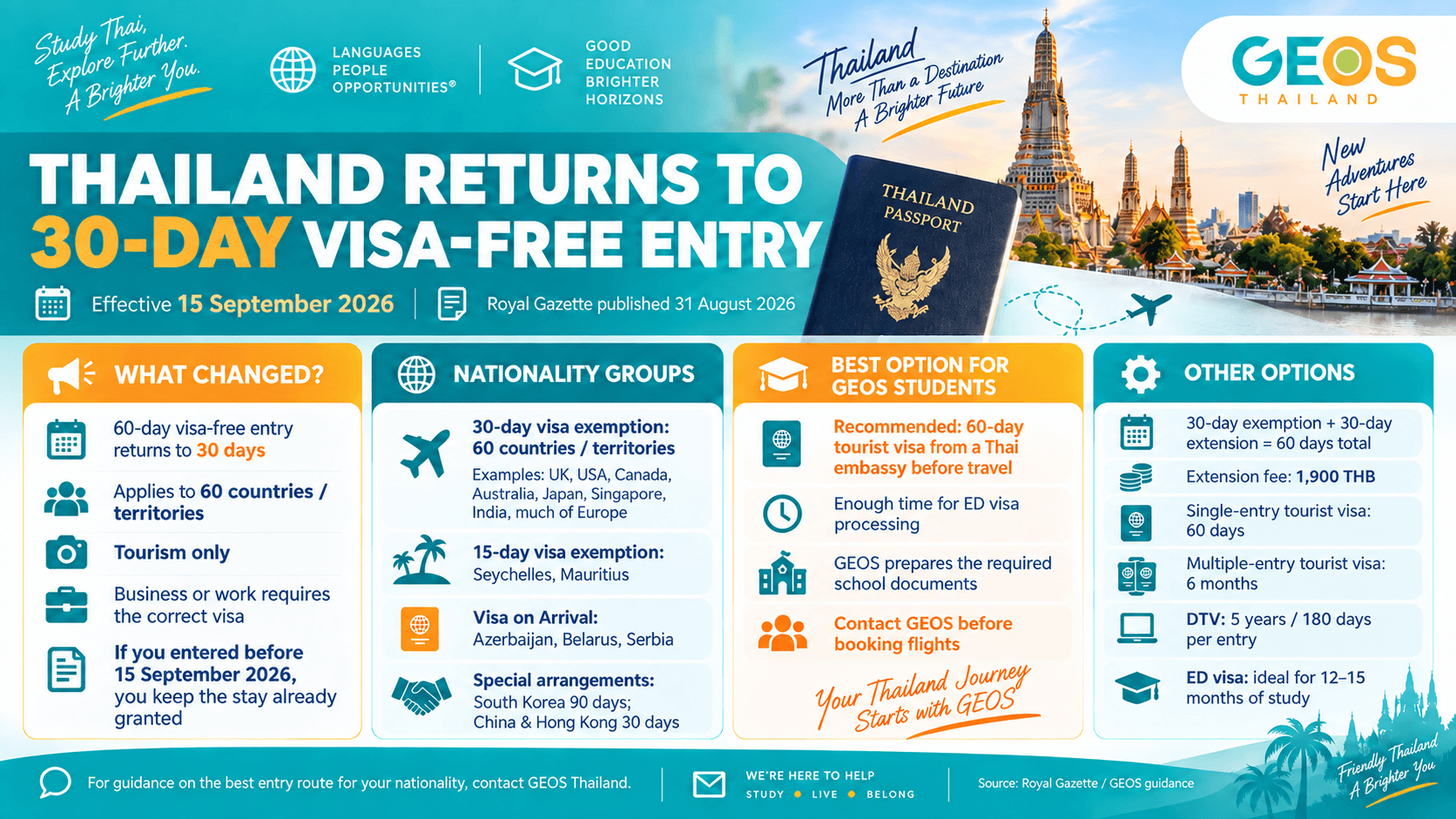
This is GEOS’s first recommendation, and it is completely unaffected by the new exemption rules. Before you travel to Thailand, apply for a tourist visa at a Thai embassy in your home country. This gives you 60 days on arrival — more than enough time to complete the ED visa application process, which typically takes 30 to 45 days.
The advantages of this route:
GEOS prepares all documentation for the ED visa application process, including your MOE acceptance letter and police clearance. Contact GEOS before you book your flights so we can confirm your timeline.
If you arrive on the standard visa exemption, you can extend your stay by 30 days at a local immigration office inside Thailand for 1,900 THB. This gives you 60 days total — tight, but workable for most ED visa applications if you start the process on day one.
What you need to know about this route:
If your 60-day visa runs out before your ED visa is approved, you would need to leave Thailand and re-enter, which is why the 60-day tourist visa from a Thai embassy is the safer starting point.
If you want to live and study in Thailand for 12 to 15 months, an ED visa is the cleanest legal option available. It is issued specifically for students enrolled at a Ministry of Education-recognized language school and gives you a structured, renewable stay without visa runs or immigration anxiety.
What an ED visa at GEOS includes:
One important caveat: the ED visa is designed for students who intend to stay in Thailand and study. If you plan to travel frequently around Asia, leave and re-enter Thailand regularly, or treat Bangkok as a base rather than a home, the ED visa is not the right option for you. Immigration officers question the authenticity of ED visas when they see frequent border crossings — it raises doubts about whether you are genuinely studying. If you want the freedom to travel, look at the DTV or a tourist visa instead. The ED visa is the right choice for people who want to commit to living in Bangkok, learning a language, and making the most of the full program.”
The ED visa is not affected by the new 30-day exemption rule — once approved, your legal stay is determined by your visa, not by entry stamps. The rule change affects how you arrive, not how long you can legally remain once enrolled.
Full ED visa document checklist — including what GEOS prepares and what you need to bring.
The DTV is designed for remote workers, digital nomads, and freelancers who want to spend extended time in Thailand without a tourist visa. It allows a 180-day stay per entry and can be renewed. It does not permit employment with Thai companies and does not include the educational structure or MOE recognition of an ED visa. If your primary goal is studying a language in Bangkok, the ED visa is a better fit.
Thailand also offers retirement visas (Non-Immigrant O-A, for those over 50), marriage visas (Non-Immigrant O), and business visas (Non-Immigrant B). These fall outside GEOS’s area of expertise. For guidance on these options, consult a licensed Thai immigration lawyer or the Thai Immigration Bureau directly.
Thai Immigration Bureau — official information on all visa categories and requirements.
China and Hong Kong: Under a bilateral arrangement, Chinese and Hong Kong nationals receive 30 days on arrival — the same effective window as the general exemption countries. Chinese students are not newly restricted by the May 2026 change, but 30 days has always been a tight timeline. GEOS recommends applying for a 60-day tourist visa at the Thai embassy in China before departure.
India: Indian nationals are on the 30-day visa exemption list, the same as most Western countries. This is a change from earlier expectations that India would move to Visa on Arrival. For Indian students enrolling at GEOS, the same guidance applies as other 30-day exemption countries: a 60-day tourist visa from a Thai embassy is the safer route if you plan to complete the ED visa process without an extension visit.
South Korea: Korean nationals benefit from a 90-day bilateral arrangement — comfortably above the time needed for the ED visa process. No change is required for Korean students following GEOS’s standard enrollment timeline.
Japan: Japanese nationals receive a 30-day exemption under the new rules. GEOS recommends Japanese students apply for a 60-day tourist visa at a Thai embassy in Japan before departure to ensure sufficient time for the ED visa process without an extension visit.
GEOS will produce nationality-specific guidance for the countries most affected by the new rules. If your nationality is not covered above and you are planning to enroll at GEOS, contact us before booking your flights so we can confirm your recommended entry route.
The rules are now confirmed and take effect September 15, 2026. If you were admitted before that date, you keep the 60-day stay you were granted on arrival.
Yes. Apply for a 60-day tourist visa at a Thai embassy in your home country before you travel. This is GEOS’s recommended first step for all new students. It is unaffected by the visa exemption change and gives you the most comfortable timeline for completing the ED visa process. Contact GEOS before booking your flights to confirm the right approach for your nationality.
No. The ED visa is a separate visa category issued specifically for students at MOE-recognized schools. Once your ED visa is approved, your legal stay in Thailand is determined by your visa — not by the visa exemption rules. The change affects how you enter Thailand before your ED visa is processed, not the visa itself.
If you extend by 30 days at Immigration and the ED visa is still processing, you would need to leave Thailand and re-enter. This is why GEOS recommends arriving on a 60-day tourist visa rather than a 30-day exemption. If you are already in Thailand and running short on time, contact GEOS immediately so we can assess your timeline and options.
Yes. You can extend a visa exemption by 30 days at a local immigration office for 1,900 THB, giving you 60 days total. Thailand also limits visa exemption extensions — the first extension gives you 30 days, but any second extension is only 7 days. This means the realistic maximum on a visa exemption stay in Bangkok is 30 days entry + 30-day extension + 7-day extension = 67 days total. For most ED visa applicants, one extension of 30 days is sufficient.
Yes. GEOS English classes — including Callan Method group and private lessons — are open to everyone, not just ED visa students. Thai nationals, expats, and visitors are all welcome. No visa is required to join as a local student. Contact GEOS to check current class availability and find the right level for you.
Thailand’s return to 30-day visa exemptions changes the arrival window, not the long-term options available to students. The 60-day tourist visa from a Thai embassy remains the cleanest route for anyone planning to enroll at GEOS, and the ED visa remains the most stable legal basis for extended study in Bangkok.
It is also worth putting this in perspective: the 30-day rule is not new. Every language school in Thailand, including GEOS, operated under this rule for years before the 60-day exemption was introduced in 2024. We know this process well. It requires a little more planning, and students need to know their options before they arrive — but it is straightforward, and thousands of students have successfully enrolled at GEOS under exactly these conditions.
At GEOS, we have guided students through Thailand’s visa system for over 20 years — through policy changes, pandemic disruptions, and new enforcement measures. Our staff will be producing nationality-specific video guidance for the countries most affected by this change. In the meantime, contact GEOS before you book your flights, and we will confirm the right entry route, application timeline, and documents for your specific nationality.
Explore our collection of captivating articles, each offering a unique perspective
GEOS Thailand is conveniently located in the heart of Bangkok, close to Asoke BTS and Sukhumvit MRT stations.
enquiry@geosthai.com