
Group Thai classes at GEOS include ED visa sponsorship and are best for students planning to live in Bangkok for up to 14 months. Private Thai lessons are better suited to students who do not need a visa, want to set their own pace, or prefer a teaching style tailored specifically to their learning background. After 20+ years of MOE recognition and thousands of students through both formats, the honest answer is that the right choice depends on why you are in Bangkok and how long you plan to stay. At GEOS, both formats use the Direct Method, meaning Thai is spoken from the first lesson and translation is minimized throughout. One advantage that genuinely separates GEOS from other Bangkok language schools is that some of our Thai teachers speak Japanese, making private lessons particularly effective for Japanese nationals learning Thai. Here is what each format offers, where they differ, and how to decide which one fits your situation.
Both formats are taught using the Direct Method: Thai from the first lesson, no translation, speaking and listening emphasized throughout. The differences are in structure, pace, and what each format is designed to achieve.
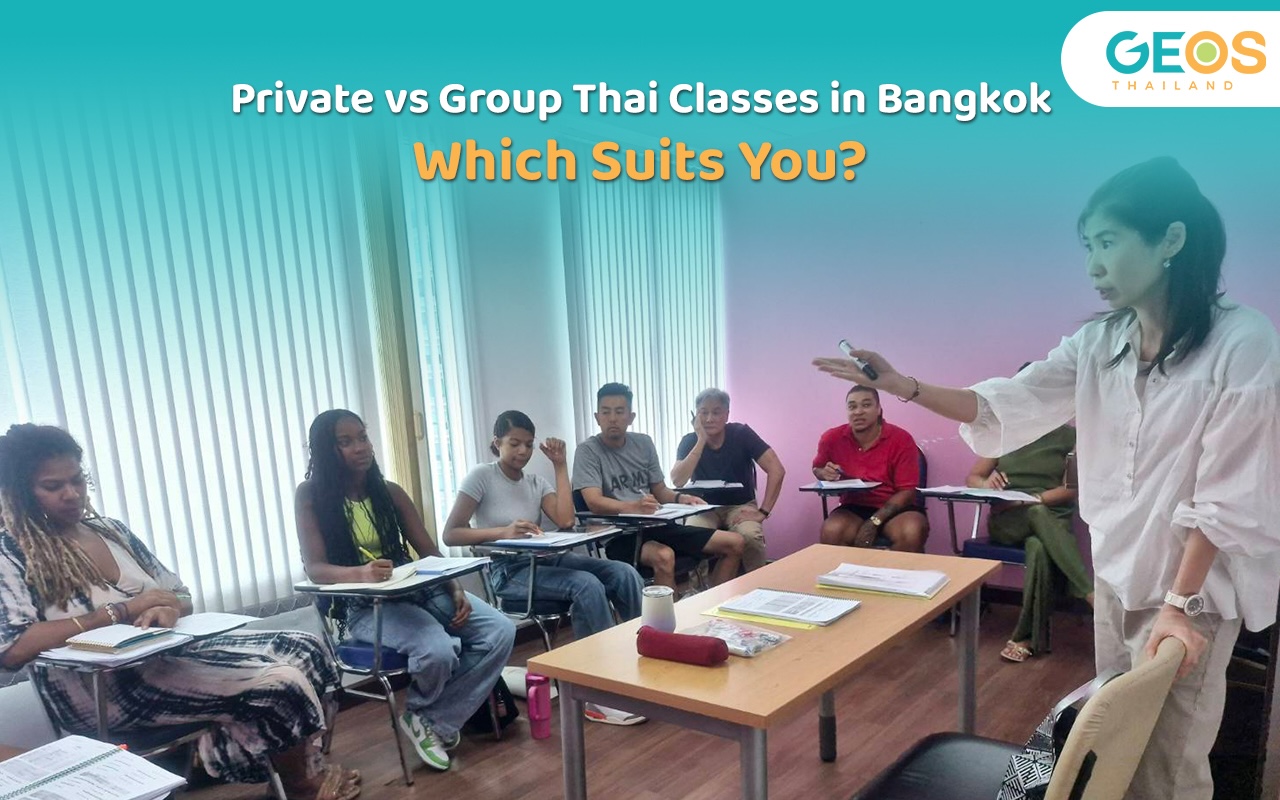
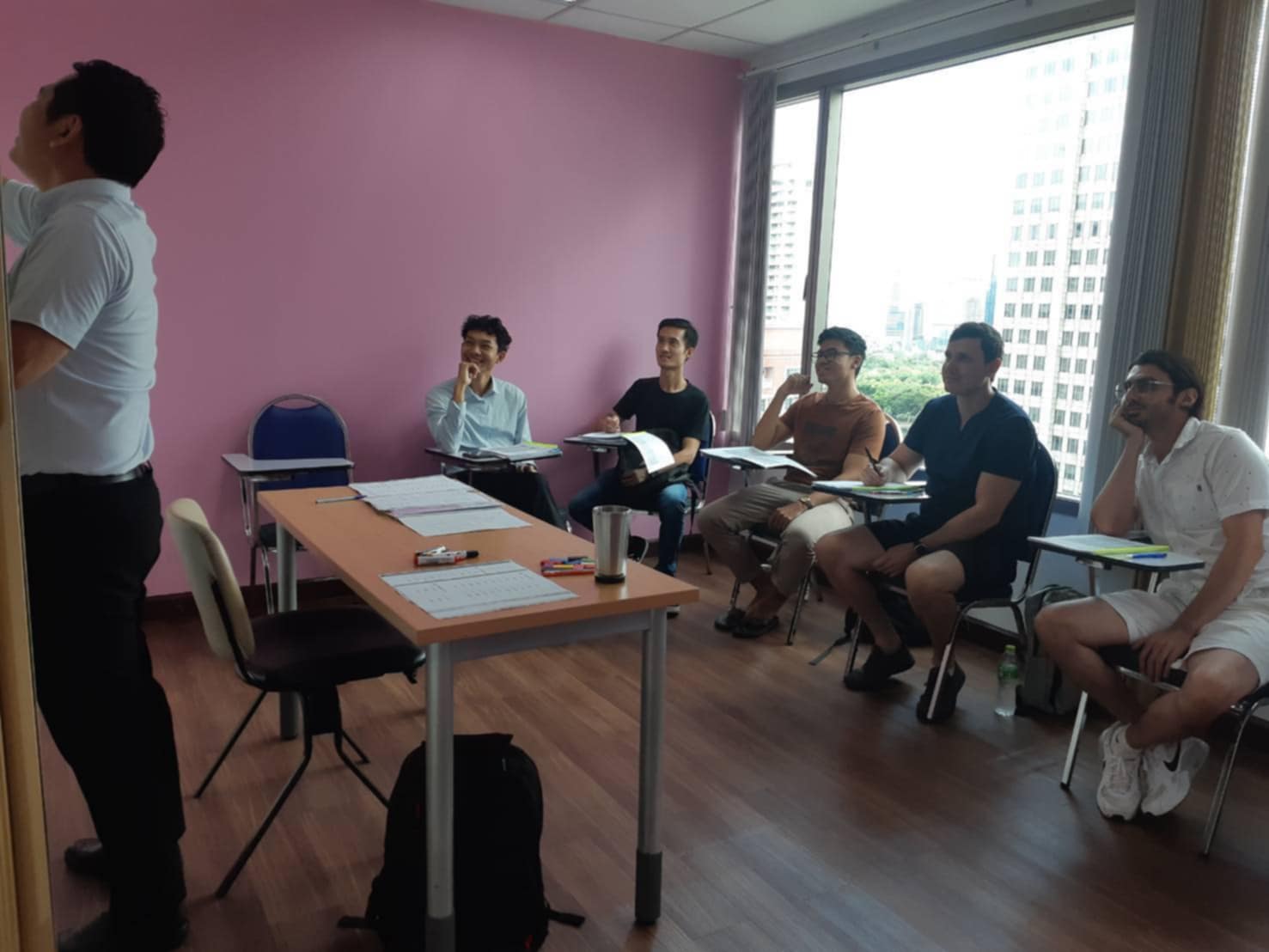
Group Thai classes follow a structured curriculum across four modules, from beginner to upper-intermediate. Classes run three times per week at nine hours per week. Students progress through the program together, which means the pace is set by the curriculum rather than by individual preference. The group format is tied to the ED visa program, which gives students up to 14 months of legal stay in Thailand specifically for educational purposes.
Private Thai lessons at GEOS are one-on-one sessions with a GEOS Thai teacher. The student sets the pace and direction. You can spend additional time on tones if that is where you are struggling, move faster through grammar you already understand, or adjust the content to match how you learn best. Private lessons do not include ED visa sponsorship and are designed for students who are already in Thailand legally on another visa, or who simply want flexible supplementary Thai practice.
For a full breakdown of what the group Thai program covers at each level, see our Thai language learning timeline.
Group classes are the right choice if:
The group format also builds something that private lessons cannot replicate: a community. GEOS students come from over 40 nationalities. The mix of backgrounds in a group Thai class creates genuine peer practice, where students use Thai with each other in addition to with the teacher. Students often tell us that some of their most useful Thai practice happened between classmates, not just with the teacher.
Group classes at GEOS run at fixed times across multiple scheduling options. Students attend consistently and progress through the four-module program at the curriculum’s pace. If you want the ED visa and a structured path from beginner to upper-intermediate Thai, the group program is the right choice.
Private lessons are the right choice if:
That last point deserves extra attention. GEOS has Thai teachers who speak Japanese. For Japanese nationals learning Thai, having a teacher who can clarify grammar in Japanese when a concept is not landing in the Direct Method is genuinely valuable. Thai and Japanese share some structural similarities that an English-speaking teacher cannot leverage.
Private lessons also suit students who have irregular schedules. Group classes run at fixed times and require consistent attendance. A private student can schedule sessions around work, travel, or other commitments without falling behind a class.
This is the most common question and the honest answer is: it depends on the student, not the format.
Private lessons allow faster acceleration through content you already understand. If a student has some prior Thai exposure, private lessons let them skip material they have already covered and focus entirely on gaps. For a student starting from zero, the pace advantage of private lessons is less clear, because the foundations take time regardless of format.
Group classes offer something private lessons cannot: the experience of hearing other students make mistakes, watching corrections happen, and processing Thai from multiple speakers and accents. Students in group classes get more total hours of Thai input per session because the teacher is speaking the whole time, feeding and correcting all students simultaneously. In the Direct Method, listening to another student’s answer is also practice.
Based on recent GEOS student experiences, students in the group program who attend consistently and engage with Bangkok life outside the classroom make the fastest overall progress. The structure keeps them accountable, the community keeps them motivated, and the city provides constant opportunities to practice.
Yes, significantly. The ED visa is tied to the group Thai program at GEOS. It requires enrollment in a recognized educational institution under a structured curriculum with a minimum weekly study commitment. Private lessons at GEOS do not qualify for ED visa sponsorship.
The Ministry of Education requires a structured group program with demonstrable enrollment and attendance. If you are planning to stay in Bangkok for more than a few months and need a legal long-term visa, the group program is your path.
If you are already on an ED visa through the GEOS group program and want additional practice on top of your regular classes, private supplementary lessons are a natural option. Some GEOS students do exactly this, using private sessions to accelerate specific areas while the group program covers the curriculum.
For more on the ED visa process at GEOS, see our Thai language ED visa document checklist.
Group Thai classes at GEOS are structured as pay-per-term, with three terms across the 14-month program. The full program cost is 55,000 THB paid per term. This works out to approximately 3,900 THB per month for a nine-hour-per-week program, which is among the strongest value in Bangkok for a structured, MOE-recognized Thai course.
Private lesson pricing is available on request and varies depending on session frequency and teacher. Private lessons are priced per session rather than as a program fee.
When comparing costs, factor in what each format includes. Group classes at GEOS include ED visa sponsorship, MOE acceptance letter processing, police clearance collection, and accompaniment to your first Chaeng Watthana Immigration appointment. None of these are included in private lessons, because private students do not require them. For students who do need the ED visa, the group program’s full-service approach represents significantly better value than the tuition cost alone suggests.
Yes. Students who start with private lessons and later decide they want the ED visa, the structured curriculum, or the group environment can transition to the group program. Contact GEOS to discuss your current level and find the right starting point in the four-module curriculum. A level assessment will place you at the appropriate stage rather than starting from the beginning if you already have some Thai.
Yes. Some GEOS Thai teachers speak Japanese, which is particularly useful for Japanese nationals learning Thai. Having a teacher who can explain grammar concepts in Japanese when the Direct Method alone is not landing makes a meaningful difference to how quickly students understand structural patterns in Thai. This is one of the specific advantages GEOS offers that most Bangkok language schools cannot match.
Yes. Some GEOS students combine both formats, using the group program as their core curriculum and ED visa basis, and adding private sessions to accelerate specific areas where they want extra practice. Speaking fluency, reading Thai script, and tonal accuracy are common areas where students use private sessions to supplement group class progress. Contact GEOS to discuss scheduling.
Private lesson arrangements at GEOS are flexible. Unlike the group program, which follows a structured 14-month curriculum, private lessons can be booked on a session-by-session basis or as a regular schedule depending on what suits the student. Contact GEOS directly to discuss availability and frequency that fits your schedule and learning goals.
Both formats work for complete beginners, but the group program is generally the better starting point if you are planning a long stay in Bangkok. The structured curriculum is specifically designed to build from zero, the regular schedule creates accountability, and the community provides motivation. Private lessons from zero are also effective but work best for students with a specific timeline or learning style that does not fit a fixed schedule.
Explore our collection of captivating articles, each offering a unique perspective
GEOS Thailand is conveniently located in the heart of Bangkok, close to Asoke BTS and Sukhumvit MRT stations.
enquiry@geosthai.com