Thailand Visa Exemption 2026: Is the 60-Day Rule Ending?
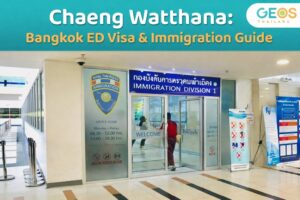
Thailand’s visa exemption is under formal review in 2026, with a proposal to cut visa-free stays from 60 days to 30 days, currently before the Thai government. Border enforcement has already tightened, and ED visa holders who travel abroad are now being questioned about course attendance on re-entry. For language students planning an extended stay in Bangkok, an ED visa provides legal long-term residency that the visa exemption scheme was never designed to cover. At GEOS, we have processed thousands of ED visas over 20+ years with a 100% approval rate for complete applications. Our staff accompany every student to their first Immigration appointment at Chaeng Watthana. Here is exactly what is happening in 2026 and what it means for you.

Is Thailand Reducing the Visa Exemption from 60 Days to 30 Days?
A formal proposal is currently under government review. No implementation date has been announced.
Thailand expanded its visa-free entry period from 30 to 60 days in July 2024, opening the scheme to citizens of 93 countries as part of a post-pandemic tourism recovery plan. It worked. Tourist numbers increased significantly.
The problem is that some visitors use the extended window for purposes beyond short-term tourism: long-term stays, repeated back-to-back entries, and, in some cases, unauthorized work. Thai officials openly flagged these concerns, and on February 10, 2026, the Cabinet formally acknowledged the issue and reappointed a visa policy committee to review the scheme.
According to the Thai Ministry of Foreign Affairs, any reduction would require government approval and an official announcement before taking effect. For now, the 60-day exemption remains valid. For now, the 60-day exemption remains valid. Thai authorities have stated that travelers will receive adequate notice before any changes take effect. Because the proposal must still pass through the Cabinet, implementation will not happen overnight.
If you are planning to study in Bangkok and have not yet enrolled, do not wait for this to be resolved. Start your ED visa application now while the longer window is still available.
What Has Already Changed at the Border in 2026?
The policy proposal has not passed yet, but enforcement changed at the beginning of 2026.
Immigration officers are applying stricter checks on entry regardless of nationality or visit history. Officers are now routinely asking arriving travelers to show:
- A return or onward ticket confirming you plan to leave
- Proof of accommodation and a basic travel itinerary
- Proof of funds: 20,000 THB per person or 40,000 THB per family (cash or equivalent hard currency)
- A valid passport with at least 6 months remaining, in good condition with no damage or missing pages
These requirements are not new. They have always been part of Thailand’s entry conditions. What changed in 2026 is that officers are consistently checking them.
One practical point for anyone arriving soon: all travelers must complete the Thailand Digital Arrival Card (TDAC) online within three days before arriving. This replaced the old paper arrival cards. If you have students or contacts traveling to Thailand, make sure they know about this before they fly.
How Does Border Scrutiny Affect People on Visa Exemptions?
Thailand has no official annual cap on the number of visa-exempt entries. However, immigration officers review your full passport history when you arrive, not just your current-year stamps.
Spending more than 60 days in Thailand in a calendar year may prompt questions at the border. Based on reports from early 2026, spending more than 157 days has been treated as evidence of long-term residency rather than tourism, and entry has been denied on this basis.
For anyone planning to study Thai, English, or Japanese in Bangkok for several months, this is the clearest signal yet that the visa exemption is the wrong tool for the job. It was designed for short-term tourism. Extended language study requires the right visa.
What Do ED Visa Holders Need to Know Before Travelling Abroad?
This is important, and it is specific to 2026.
If you hold a Thai ED visa and travel outside Thailand, immigration officers may question you closely on re-entry. Based on information from our contacts within the Immigration Bureau, officers are scrutinising the travel patterns of ED visa holders more carefully, particularly students who travel frequently or spend extended time abroad mid-course.
The reasoning is straightforward. If you are enrolled in a language program but leaving Thailand regularly, immigration will question whether you are genuinely attending class.
Official written guidance on this is expected to be issued. GEOS will update this post as soon as confirmed policy is published.
In the meantime, here is what we recommend:
- Attend class consistently. This is your strongest protection against any re-entry question. GEOS tracks student attendance and that record matters.
- Carry your course schedule or any documentation confirming active enrolment when you travel.
- Avoid extended trips abroad mid-term, particularly during active visa extension periods.
- Talk to GEOS before you book travel. We can advise you on timing relative to your course schedule and upcoming Immigration appointments.
This is not a reason to avoid studying in Thailand. It is a reason to be enrolled in a legitimate, MOE-recognized program and attending class. Both of those things are standard for GEOS students.
Already Outside Thailand? Here Are Your Three Options
If you have not yet entered Thailand and want to enroll in an ED visa course, you have three practical routes.
Option 1: Apply for a 60-day tourist visa before you arrive. Visit your nearest Thai embassy and apply for a tourist visa before traveling. This gives you 60 days in Thailand plus the option to extend by 30 days at Immigration, providing a comfortable window to complete your ED visa application. We recommend this option for most students. You can apply for a tourist visa online through the Thai e-Visa portal before you travel.
Option 2: Enter on a 30-day visa exemption and extend at IT Square Lak Si. If a tourist visa is not practical, you can enter on a standard 30-day visa exemption and apply for a 30-day extension at IT Square Lak Si Immigration. This gives you enough time to complete the ED visa process before your permitted stay expires. Contact GEOS immediately on arrival so we can begin your application without delay.
Option 3: Apply for your ED visa from your home country. If you prefer to arrive in Thailand already holding your ED visa, GEOS can support your application from abroad. You will need a friend or family member already in Thailand who can pay your first term fees and receive the paperwork on your behalf. Contact us before you travel and we will walk you through the process step by step.
Why Does the ED Visa Eliminate This Uncertainty?
An ED visa is issued specifically for students enrolled in accredited language programs. It provides legal long-term residency in Thailand for the full duration of your course: 12 months for English, 14 months for Thai, and 15 months for Japanese at GEOS.
When you hold an ED visa:
- You are not affected by changes to the visa exemption scheme
- You have a Ministry of Education-backed reason to be in Thailand
- Your stay is documented, structured, and fully compliant with immigration requirements
- You are not subject to the 157-day tourism scrutiny or repeated entry questioning
GEOS has maintained MOE recognition for over 20 years. When we issue your acceptance letter, it carries institutional weight at Chaeng Watthana Immigration. Our staff accompany every student to their first Immigration appointment, and we have maintained a 100% approval rate for complete applications throughout that time.
What Does the ED Visa Application Process Look Like?
The visa exemption changes do not affect the ED visa application process itself. The steps remain the same.
If you are currently in Thailand on a visa exemption, you can convert to an ED visa without leaving the country, as long as you have enough time remaining. We recommend at least 45 to 60 days remaining on your current stamp before starting the process. If a criminal background check is required for your nationality, allow 50 to 60 days.
- Enroll at GEOS and pay your first term
- GEOS collects your documents: passport, passport photos, and TM30 registration
- GEOS prepares your MOE acceptance letter
- Our staff accompany you to Chaeng Watthana for your first appointment
- You receive a receipt stamp and return in approximately 10 to 15 days for your approval
One important restriction: you cannot travel outside Thailand between your first Immigration appointment and final approval. Airport immigration can cancel applications that are in progress. Plan any travel before you begin the process, not during it.
If you have fewer than 30 days remaining on your current stamp, you will need to leave Thailand and apply at a Thai embassy abroad. Option 1 or Option 3 above applies in that case.
Do I Need to Pay for the Whole Year Upfront?
No. GEOS uses a pay-per-term model, so you commit to one term at a time.
The English program costs 28,500 THB for the first term. You continue into the second and third terms from there, or pay the full year upfront at a 10% discount (49,500 THB total). Either way, you are not committing to 12 months of fees before you have attended a single class.
Once your visa is sorted, many students focus on practical next steps like opening a Thai bank account, which your GEOS enrollment documents can help support.
FAQs
No. As of March 2026, this remains a proposal under government review. No implementation date has been announced, and the current 60-day exemption is still valid. Any change requires an official government announcement before it takes effect. GEOS will update this post when confirmed policy is issued.
Yes, provided you have sufficient time remaining on your stamp. GEOS recommends at least 45 to 60 days to allow for standard processing. If your situation is tighter than that, contact us before enrolling and we will review your options. Requirements may vary depending on your nationality.
Immigration officers are now scrutinising the travel patterns of ED visa holders more closely. Students who travel frequently or spend extended time abroad may be questioned about whether they are genuinely attending class. Based on our contacts at the Immigration Bureau, formal written guidance on this is expected. The clearest protection is consistent class attendance and holding a valid ED visa from a MOE-recognized school.
Officers are currently asking for 20,000 THB per person or 40,000 THB per family in hard cash or equivalent hard currency. This is an existing requirement that is now being enforced more consistently in 2026. Travelers should carry this with them, not rely on bank statements alone.
English program students visit Chaeng Watthana Immigration five times over 12 months. Thai program students visit seven times over 14 months. Japanese program students visit three times over 15 months. Each visit costs 1,900 THB for the extension fee. GEOS staff accompany you to your first appointment.
The TDAC is a digital arrival form that all travelers must complete online within three days before arriving in Thailand. It replaced the old paper arrival cards. You can complete it at tdac.immigration.go.th. Failure to complete it before arrival may cause delays at immigration.
Yes. Officers have discretionary authority to deny entry to anyone they believe is using visa exemptions for long-term residence rather than genuine tourism. Officers review your complete passport history. Multiple entries, extended stays, and limited time abroad all raise the likelihood of questions. An ED visa removes this uncertainty entirely.
Yes. If you have a friend or family member already in Thailand who can pay your first term fees and receive the paperwork on your behalf, GEOS can manage your application from abroad. Contact us before you travel and we will confirm whether your situation is suitable for this option.
Ready to Make Your Stay in Thailand Official?
Thailand’s visa environment in 2026 rewards people who plan ahead. The exemption scheme is under pressure, border enforcement is stricter, and ED visa holders who travel are facing closer scrutiny on re-entry. None of this affects students who are properly enrolled, genuinely attending class, and holding a valid ED visa from a MOE-recognized school.
At GEOS, we handle the paperwork, accompany you to your first Immigration appointment, and have maintained a 100% approval rate for complete applications over 20 years. Pay-per-term pricing means you start your first term for 28,500 THB with no large upfront commitment.
Contact GEOS today. We will review your current visa situation and walk you through the right option for you.
Explore Our Magazine
Explore our collection of captivating articles, each offering a unique perspective