
Thailand’s non-immigrant ED visa allows foreign students to stay in Thailand legally for 12 to 15 months, depending on which language course they study. You apply through a Ministry of Education-recognized school, which issues your acceptance letter and handles all Immigration paperwork. At GEOS Language Centre, our 20+ years of MOE recognition and 100% approval rate for complete applications mean students start with confidence rather than paperwork stress. Most GEOS students arrange their ED visa while already in Thailand, with our staff accompanying them to Chaeng Watthana Immigration for the application appointment. Here is what you need to know before enrolling.
Note: As of February 2026, Thailand is reviewing a potential reduction of the visa-free stay from 60 to 30 days. No decision has been made. We will update this page when confirmed.

The non-immigrant ED visa is a single-entry visa designed for people who want to study full-time at an MOE-recognized school in Thailand. It is not a tourist visa extension or a visa run workaround. It is a legitimate long-term visa category, supported by the Thai Ministry of Foreign Affairs, that allows you to live and study in Thailand legally.
At GEOS, students use the ED visa to study Thai, English, or Japanese. Your first ED visa stamp is valid for 90 days. Your school then guides you through extensions at Immigration so you can keep studying without interruption.
Your total length of stay depends on which course you study:
English Program: 12 months without leaving Thailand First ED visa: 90 days, then 5 extensions through Bangkok Immigration. You never need to leave Thailand during the English program.
Thai Language Program: 14 months total First period: approximately 8 months. You then exit Thailand, reapply at a Thai embassy abroad, and return for a second period of approximately 6 months.
Japanese Language Program: 15 months total First period: approximately 10 months, followed by a second period of approximately 5 months after reapplying abroad.
Many GEOS students combine courses to extend their time in Thailand. Studying Thai for 14 months, then English for 12 months, gives you over two years of legal, continuous stay. Each course requires a separate ED visa application.
According to the Thai Immigration Bureau, extensions are granted based on your course schedule and attendance record. GEOS submits extension documents on your behalf and accompanies you to Chaeng Watthana for each appointment.
There are two ways to apply:
Option 1: Apply from within Thailand (most common) Most GEOS students arrive on a 60-day visa exemption and apply for their ED visa while already in Thailand. You need at least 45 days remaining on your current entry stamp to complete the process safely. GEOS handles all MOE paperwork and accompanies you to Chaeng Watthana Immigration for your first appointment. The process takes 30 to 35 days from enrollment to approval, or 50 to 55 days if you need a criminal record check.
Option 2: Apply at a Thai embassy before arriving Enroll at GEOS, receive your MOE acceptance letter, then apply at your nearest Thai embassy. Most embassies process ED visa applications within 3 to 5 business days. This option suits students who want everything confirmed before they travel.
For a step-by-step breakdown of both routes, see our tourist visa to education visa guide.
GEOS prepares most of your documents. You provide the following:
GEOS prepares your MOE acceptance letter, school enrollment confirmation, class schedule, and all Immigration forms. There is no proof of funds required when applying from within Thailand.
Students from certain African, Asian, and Middle Eastern countries also need a criminal record check. African students require checks from both their home country and Thailand. Students from Bangladesh, China, India, Nepal, Pakistan, Sri Lanka, and several Middle Eastern countries need a Thailand criminal record check only. GEOS guides you through this process. For the full country list, see our criminal record check guide.
90-day reporting: Every three months, you must report your current address to Thai Immigration. GEOS reminds you before each deadline and prepares your documents. Missing a report results in a 2,000 THB fine.
Re-entry permits: If you travel outside Thailand during your studies, you must buy a re-entry permit before departure. Without one, your visa extension is cancelled the moment you exit. Single permits cost 1,000 THB, multiple-entry permits cost 3,800 THB. Both are available at Chaeng Watthana or at international airports before your flight.
Attendance: You must attend at least 80% of your classes. Immigration officers may request attendance records when you apply for extensions. GEOS tracks attendance and provides records when needed.
Work restrictions: The ED visa is for education only. Working on an ED visa is illegal and can result in deportation and an entry ban.
Yes, significantly. All ED visa schools must hold an MOE license, but the quality of support varies widely. Some schools focus entirely on the visa and provide minimal or irregular teaching. Students often discover this after paying upfront.
Before committing, always take a trial lesson. Check that classes are small, teachers are qualified, and the school physically accompanies you to Immigration rather than just handing you a document checklist.
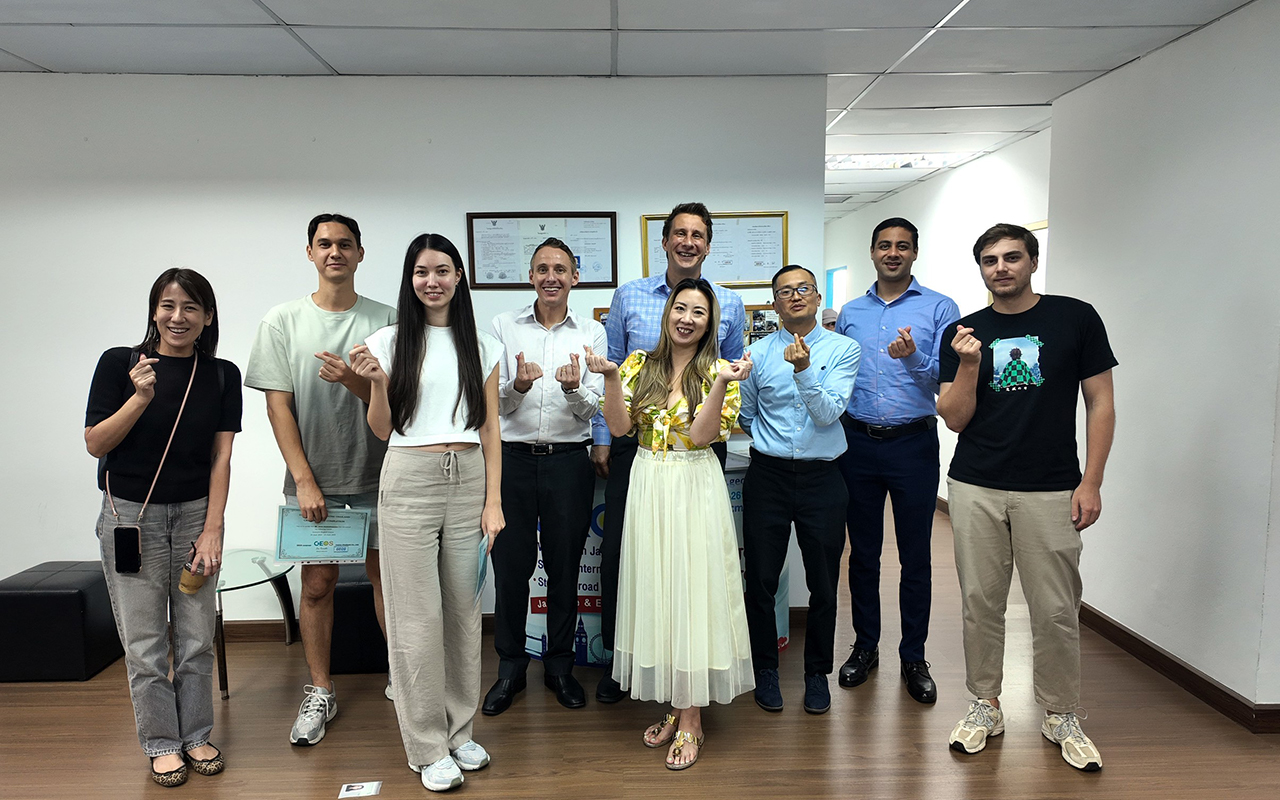
At GEOS, you can sit in on a lesson before enrolling. Our classes are capped at 15 students, our teachers are experienced, and our staff walk with you to Chaeng Watthana for your first Immigration appointment. We have processed thousands of ED visas over 20 years and maintained a 100% approval rate for complete applications. Most Bangkok schools explain the process and send students to Immigration alone. We go with you.
GEOS also runs bi-monthly street food tours, Thai cooking classes, and twice-monthly language exchange events. You are joining a community, not just paying for a visa vehicle.
Yes. Many GEOS students extend their time in Thailand by moving from one language program to another. For example, studying Thai for 14 months, then enrolling in the English program for 12 months, gives you over two years of continuous legal stay.
Each course requires a new ED visa application. GEOS guides you through the transition between programs and handles the paperwork for each new application.
When your course ends, you have three options:
Immigration typically gives students 7 to 15 days after course completion to either depart or change their visa type. GEOS explains your options well in advance so there are no last-minute surprises.
Yes. Most GEOS students (around 80%) apply from within Thailand on a visa exemption stamp. You need at least 45 days remaining on your stamp to complete the 30 to 35 day process safely. Contact GEOS as soon as you arrive in Bangkok.
No. When applying at Chaeng Watthana Immigration in Bangkok, there is no proof of funds or bank statement requirement. This only applies when applying at Thai embassies abroad.
You must maintain at least 80% attendance. GEOS tracks attendance and will contact you if your rate drops. Officers at Immigration may ask for attendance records when you apply for extensions.
No. The ED visa is for education only. Working without a separate work permit is illegal and can result in deportation and a future entry ban.
Yes, but you must buy a re-entry permit before leaving. Without one, your visa extension is cancelled when you exit. Single-entry permits cost 1,000 THB, multiple-entry permits cost 3,800 THB. Both are available at Chaeng Watthana or at the airport before departure.
The English and Japanese programs start at 28,500 THB for the first term. The Thai program starts at 25,000 THB. You pay 2,000 THB directly to Immigration for the visa application fee. Each extension costs 1,900 THB paid directly to Immigration. There are no hidden fees from GEOS.
Students from certain African, Asian, and Middle Eastern countries need criminal record checks as part of their application. GEOS guides you through the process. See our criminal record check guide for the full country list and what to prepare.
Yes. A Thai bank account makes daily life significantly easier for paying rent, bills, and transfers. See our guide on opening a bank account in Thailand as a foreigner for the process and which banks accept ED visa holders.
At GEOS Language Centre, we handle every step — from MOE applications and document preparation to accompanying you to Chaeng Watthana Immigration. Our 20+ years of MOE recognition and 100% approval rate for complete applications mean you start with certainty, not guesswork.
Contact GEOS today to check your current visa status, confirm your timeline, and choose your course. Our English program can start any week. Thai and Japanese programs have monthly intake dates.
Explore our Thai, English, and Japanese ED visa courses to find the right fit.
Explore our collection of captivating articles, each offering a unique perspective
GEOS Thailand is conveniently located in the heart of Bangkok, close to Asoke BTS and Sukhumvit MRT stations.
enquiry@geosthai.com