
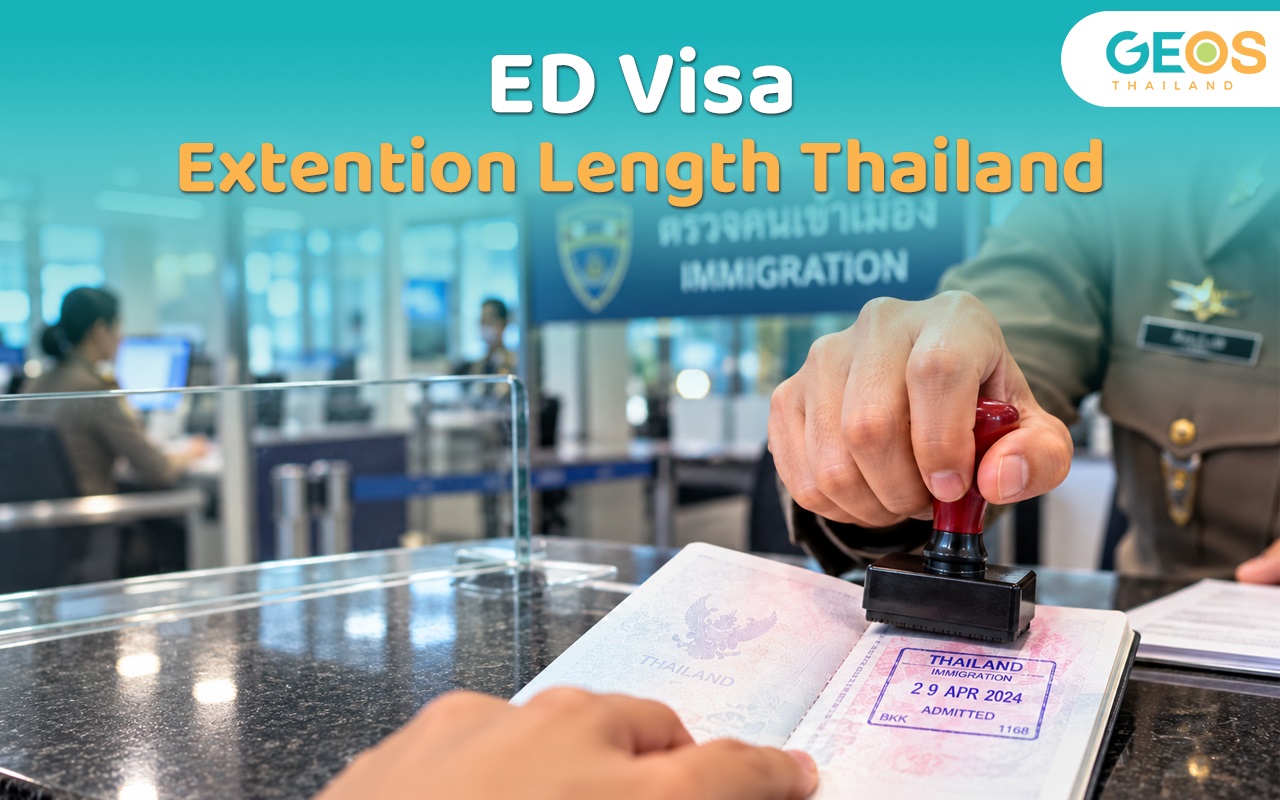
An ED visa term is set by the Ministry of Education, but the stamp in your passport is not issued all at once. ED visa extension length is capped at 90 days per stamp, so a longer term is delivered across more than one extension. This is standard across every language school in Thailand, not something specific to one program.
At GEOS, our 20+ years of MOE recognition means students are told about their ED visa extension length clearly before it happens, so each Immigration visit is expected rather than a surprise. Immigration visits typically take at least half a day, so students should plan around. Here is what a normal year of extensions actually looks like.
A full study term does not appear as one long stamp in a passport. Instead, it is issued across several extensions, and each one covers up to 90 days at a time.
If a course runs for 14 months, that full 14 months is not stamped in on day one. The first extension appears first. The next one follows once that extension ends.
This is easy to misunderstand at the start of a program. It is simply how education visas are structured in Thailand, and it applies at every language school, not just one.
Each program is approved in three terms by the Ministry of Education.
Every one of these terms is longer than 90 days. That means every term needs more than one extension, since no single stamp covers more than 90 days at a time.
The end date of each term is fixed by the Ministry of Education and does not move. If the beginner term ends on October 5, that date stays the same no matter how many extensions it takes to get there. A shorter extension along the way does not push the end date back, it just means one more visit to Immigration before that same fixed date.
For the full document checklist for each program, see our posts: Thai Language ED Visa: Complete Document Checklist, English ED Visa Course Bangkok: Complete Document Checklist
Check out our student activities, classroom tours, and campus directions before you join us.
Each term at GEOS typically needs 2 to 4 extensions, depending on how Immigration issues each stamp. This is standard across every term, whether beginner, intermediate, or advanced, and it varies from student to student.
Each visit follows the same pattern. One extension ends, the next one is issued, and the course continues. Immigration visits usually take at least half a day, so students should plan for a longer visit rather than a quick errand.
Two students in the same class can also receive different extension lengths. One might get three months, another might get one month, with no clear reason given. No school can predict or guarantee what an Immigration officer will issue, since that decision belongs entirely to Immigration.
GEOS staff accompany students to their first ED visa appointment. For each extension after that, GEOS prepares the paperwork in advance and lets students know when to go to Immigration, usually around one week before the extension is due.
Extension fees are 1,900 THB, paid directly to Immigration at the appointment. This fee is separate from tuition and is not included in the course cost.
Students attend extension appointments themselves once the paperwork is ready, but nothing is left to figure out on the day since GEOS has already prepared it.
For the ED visa process in full, including what GEOS handles at each stage, see our post: Is a Thai ED Visa Worth It? An Honest Answer
Technically, you can go to Immigration on the day your current stamp expires, or the day before. This is not recommended, since it leaves no room to fix a problem if one comes up. You can also go up to one month before your stamp expires. GEOS recommends going about one week before, or at least a few days ahead, so there is time to resolve anything unexpected.
Leaving Thailand during an ED visa requires a re-entry permit, arranged at the airport before departure. Without one, leaving the country cancels the ED visa entirely.
Timing also matters here. Students must be back in Thailand and able to attend Immigration before their current extension date. If the extension is due on October 5, being outside Thailand on that date causes real problems, regardless of the reason for travel.
GEOS does not recommend leaving Thailand during an ED visa program, since the visa is intended for study. Students who are considering travel should speak with GEOS first. The decision ultimately belongs to the student, but the risks are worth understanding before booking anything.
No. The total approved study term is set by the Ministry of Education and does not change based on how many extensions it takes. A shorter individual extension does not mean a shorter course. It only means the same total time is delivered across more visits.
This is also separate from Thailand’s visa exemption rules for tourists, which changed in 2026. Once an ED visa is issued, the study term governs the length of stay, not entry exemption rules.
For details on Thailand’s current entry rules, see the Thai Immigration Bureau
Knowing the pattern in advance is most of the preparation needed.
A study term is issued across several extensions, with each stamp covering up to 90 days at a time. This is standard for every education visa in Thailand, regardless of school or program. A shorter extension does not reduce the total length of the course. It simply means the full term is delivered across more than one visit to Immigration.
Extension length is decided by Immigration on the day and can differ between students in the same class, with no reason given. No school can predict or guarantee what an officer will issue, since that decision belongs entirely to Immigration. This has been a consistent pattern for several years.
Typically 2 to 4 extensions per term, depending on how Immigration issues each stamp. This is standard across every term, whether beginner, intermediate, or advanced. GEOS prepares the paperwork in advance and confirms when to go to Immigration for each one, though visits themselves usually take at least half a day.
No. A shorter extension is a normal part of how education visas are issued in Thailand and is not connected to the quality of an application. The total approved study term stays the same. A shorter extension only changes how many visits that term takes to complete.
The extension fee is 1,900 THB, paid directly to Immigration on the day of the appointment. It is separate from tuition and is not included in the course fee. GEOS prepares the paperwork in advance and confirms the recommended date to attend, usually about one week before the extension is due.
No. Every education visa in Thailand is capped at 90 days per extension, at every language school, regardless of the program or the institution. This is a feature of how Thai education visas work, not something specific to any one school.
No. The total study term is set by the Ministry of Education and does not change based on how many extensions it takes to complete. The full approved length of stay remains the same throughout the course, right up to the fixed end date of that term.
You can technically go on the day your stamp expires, or the day before, though this is not recommended in case a problem needs fixing. You can also go up to one month early. GEOS recommends about one week before, or at least a few days ahead, so there is time to resolve anything unexpected.
Only with a re-entry permit arranged at the airport before departure, since leaving without one cancels the ED visa. Students must also be back in Thailand before their current extension date to attend Immigration in person. GEOS does not recommend travel during an ED visa program and advises students to speak with the school first.
A study term is set once and does not change. The extensions that cover it simply come in parts of up to 90 days, a normal part of how education visas work in Thailand, at every school.
Several visits to Immigration happen along the way, each one prepared for in advance with GEOS’s help. Each visit typically takes at least half a day, so it is worth planning your schedule around it rather than expecting a quick errand. Knowing this ahead of time is what turns each extension into a routine step rather than a surprise. Contact GEOS to find out more about what a full course looks like from start to finish.
Explore our collection of captivating articles, each offering a unique perspective
GEOS Thailand is conveniently located in the heart of Bangkok, close to Asoke BTS and Sukhumvit MRT stations.
enquiry@geosthai.com