
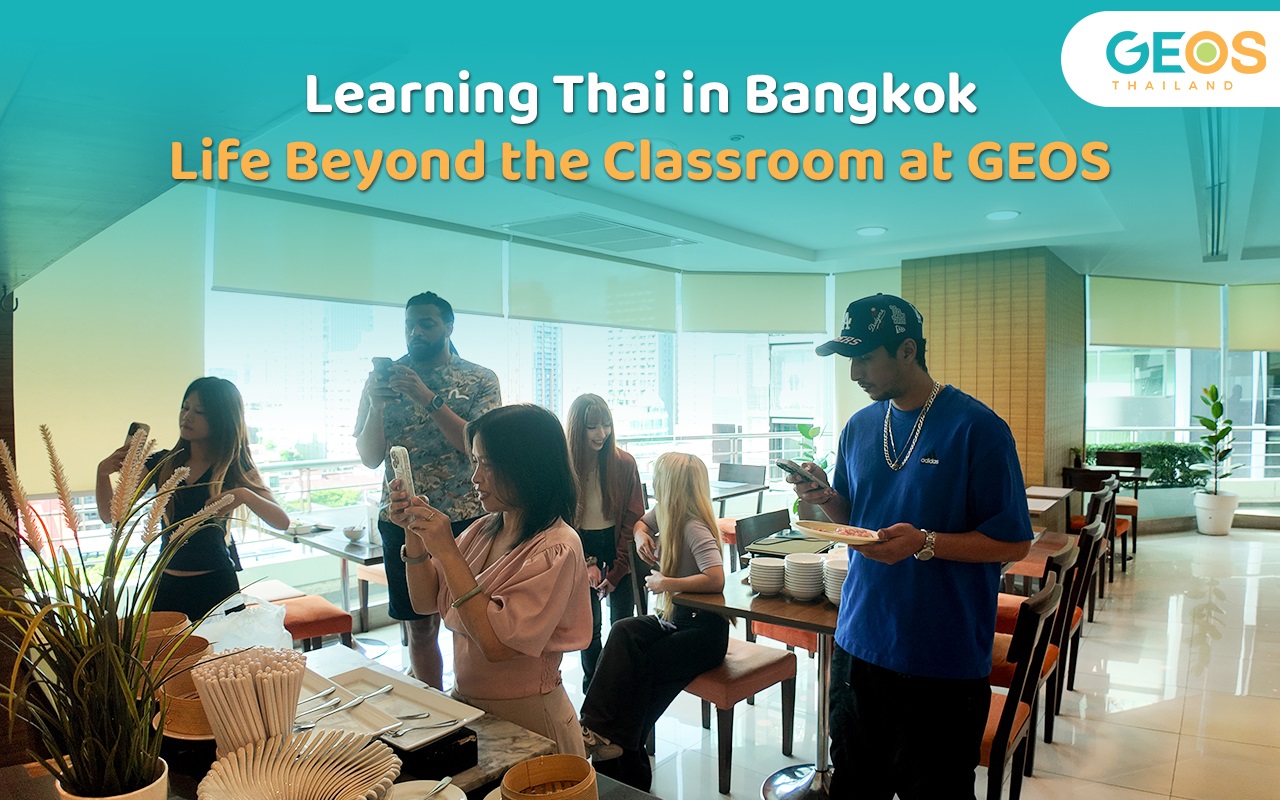
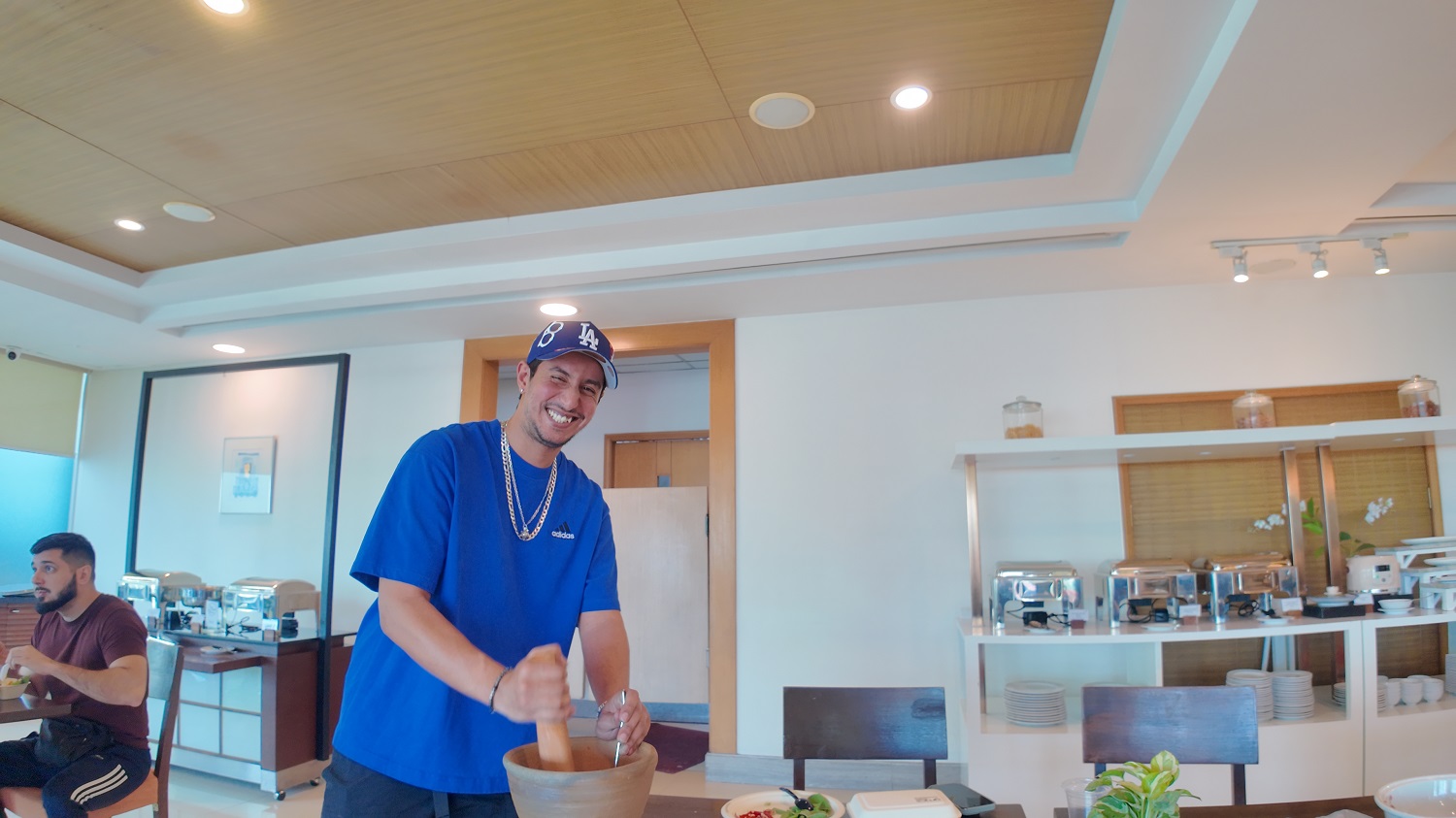
GEOS students practice Thai outside the classroom through four kinds of cultural events across the year: a cooking workshop, a drinks workshop, a Loy Krathong workshop, and an outside community event. These activities are built into the school calendar as a core part of how students integrate into life in Bangkok. On July 24, GEOS students gathered to cook Pad Krapow together, practicing Thai vocabulary for ingredients, cooking verbs, and food culture while sharing a meal with classmates from over 40 nationalities. At GEOS, our cultural program is one of the ways our 20+ years of MOE recognition becomes something students actually experience, not just a credential on a certificate. Students who engage with Bangkok’s food, festivals, and community events progress faster and settle into the city more naturally. Here is exactly how the program works and why it makes a difference to your language learning.
Most GEOS students arrive in Bangkok alone. They do not know the city, they do not know anyone at the school, and their Thai is limited to a handful of phrases. Within a few months, something changes. Students often tell us that the moment Thai started feeling real for them was not in the classroom. It was the first time they ordered food at a market using Thai they had practiced in class, or the first time a vendor in Chinatown responded to them in Thai without switching to English.
That shift does not happen by accident. It happens because GEOS builds the context for it.
Language learning research is consistent on one point: classroom instruction alone is not enough. You need exposure, repetition, and real-world use. The Direct Method that GEOS uses in the classroom is built on this principle. Thai is spoken from the first lesson, translation is avoided, and students build reflexes rather than relying on grammar rules.
The cultural program extends that same principle outside class hours. When a student learns the word for garlic (กระเทียม, kratiam) in a lesson and then uses it at a cooking workshop that same term to ask for more, the word becomes part of long-term memory rather than short-term recall. When they use a phrase they practiced that week while making a krathong float or joining the outside event, the gap between classroom Thai and real Thai starts to close.
Bangkok is an extraordinary environment for this. The city does not let you forget what you learned last week. Every taxi ride, every market visit, every restaurant order is a chance to practice. GEOS’s cultural program creates structured opportunities to do exactly that.
For context on how long the full Thai learning journey takes at GEOS, see our Thai language learning timeline.
GEOS runs four kinds of cultural events across the year, each designed to give students a real context to practice Thai outside class hours:
Each event is open to all enrolled students and included as part of the program at no extra cost. The format is deliberately social and hands-on. Students are not sitting and listening. They are cooking, making, and doing, which means they are practicing Thai in conversation rather than in repetition.
The cooking workshop is held annually and open to all enrolled students. The July 24 event focused on Pad Krapow, one of Thailand’s most recognizable dishes, held at the restaurant inside the Jasmine Hotel. Students learned the Thai names for each ingredient, the vocabulary for cooking actions (chop, fry, season, taste), and the cultural context around the dish.
The format is deliberately social. Students cook together, which means they are practicing Thai in conversation, not just in repetition. Asking a classmate to pass the fish sauce (น้ำปลา, nam pla) in Thai is a different kind of practice from answering a teacher’s question. Both matter. The cooking workshop creates the second kind.
Sharing the meal at the end of the session is equally intentional. Students from over 40 nationalities sit together around food they made themselves, speaking a language none of them grew up with. Students often tell us these sessions produce some of the strongest friendships formed at the school.
The drinks workshop runs annually and follows the same hands-on format as the cooking workshop. Students have previously made Bua Loy, a traditional Thai dessert served in warm coconut milk, learning ingredient names, colors, textures, and taste descriptions directly from Thai staff while making it from scratch.
The value of this format is the same as the cooking workshop: students are not memorizing a vocabulary list, they are using the words while their hands are on the ingredients. That combination of doing and speaking creates stronger memory than either alone.
For the full vocabulary breakdown from our dessert workshop, see our post: What Making Bua Loy Taught Our Students About Thai
The Loy Krathong workshop is held ahead of Thailand’s Loy Krathong festival, one of the country’s most visually striking celebrations. Students make traditional krathong floats by hand and learn the vocabulary and cultural meaning behind the festival, giving them context that goes beyond simply attending as a spectator.
The annual outside event takes students and staff off campus for a community gathering. Unlike the workshops, this event is less structured around a specific vocabulary theme and more focused on building relationships between students from GEOS’s wide range of nationalities in a relaxed setting.
For students planning to live in Bangkok for 12 to 15 months, cultural competence matters as much as language competence. Being able to navigate a festival, a market, a workshop, and a community event in Thai changes the quality of life in Bangkok significantly. The GEOS cultural program is built around exactly these environments.
The Tourism Authority of Thailand provides useful background on Thai festivals, including Loy Krathong, for students planning their time in Bangkok.
The ED visa exists for students genuinely enrolled in and attending a language program. GEOS’s cultural activities are part of that program, not separate from it. They reinforce classroom learning, build community, and demonstrate to students that their time in Bangkok is structured and purposeful.
Students who are engaged with the cultural program tend to progress faster, attend class more consistently, and stay for the full duration of their program. All three of these factors matter for visa extensions. Immigration officers assess whether students are genuinely studying. Students who are embedded in the language and the city present no ambiguity.
For the full ED visa process, see our ED visa application guide. For students considering whether the ED visa is the right choice, see our honest assessment: Is a Thai ED Visa Worth It?.
Cultural events at GEOS are optional but strongly encouraged. The cooking workshop, drinks workshop, Loy Krathong workshop, and outside event are all included as part of the school community program. Students who attend consistently tend to progress faster and build stronger connections with classmates. There is no extra cost for enrolled students.
The cooking workshop and drinks workshop each run annually, alongside the Loy Krathong workshop and the outside community event. This gives GEOS four cultural events across the year. The schedule is shared with enrolled students at the start of each term, so students know in advance when each event is coming up.
Yes. Cultural events are designed for all levels, including complete beginners. Staff accompany every session and help students practice at their current level. A student in their first week of class can participate in a cooking workshop and practice the vocabulary they have already learned. You do not need to wait until your Thai is confident.
Yes. Cultural events are open to all enrolled GEOS students regardless of visa type. Whether you are on an ED visa, a tourist visa, or a visa exemption, you are welcome at all school activities from your first day of enrollment. The events are part of the school community, not the visa program specifically.
Yes, indirectly. ED visa extensions require students to be genuinely enrolled and progressing. Students who are engaged outside the classroom alongside their classroom hours demonstrate genuine study. More practically, students who use Thai in real contexts progress faster, which is reflected in their language assessments. Consistent attendance and real-world practice work together.
Contact GEOS to discuss enrollment and your current language level. For the Thai program, a level assessment determines your starting point. For English, a two-part assessment places you in the correct class from day one. Cultural activities begin from your first week. Our 20+ years of MOE recognition and 100% ED visa approval rate for complete applications means the study and community experience starts on solid ground.
The city of Bangkok is one of the best language learning environments in the world. Every street, market, restaurant, and temple is an opportunity to practice Thai in a real context. GEOS’s cultural program exists to connect classroom learning to that environment in a structured, supported way.
Cooking Pad Krapow together on July 24 is one example of what that looks like in practice. Students who arrived not knowing how to ask for more basil left knowing the word and having used it in context, with classmates from across the world. Across the year, the drinks workshop, the Loy Krathong workshop, and the outside event each give students a different version of the same experience. That is the kind of learning that stays. At GEOS, we build those moments into the program deliberately, because language learning that only happens inside four walls stops at the door.
Explore our collection of captivating articles, each offering a unique perspective
GEOS Thailand is conveniently located in the heart of Bangkok, close to Asoke BTS and Sukhumvit MRT stations.
enquiry@geosthai.com