
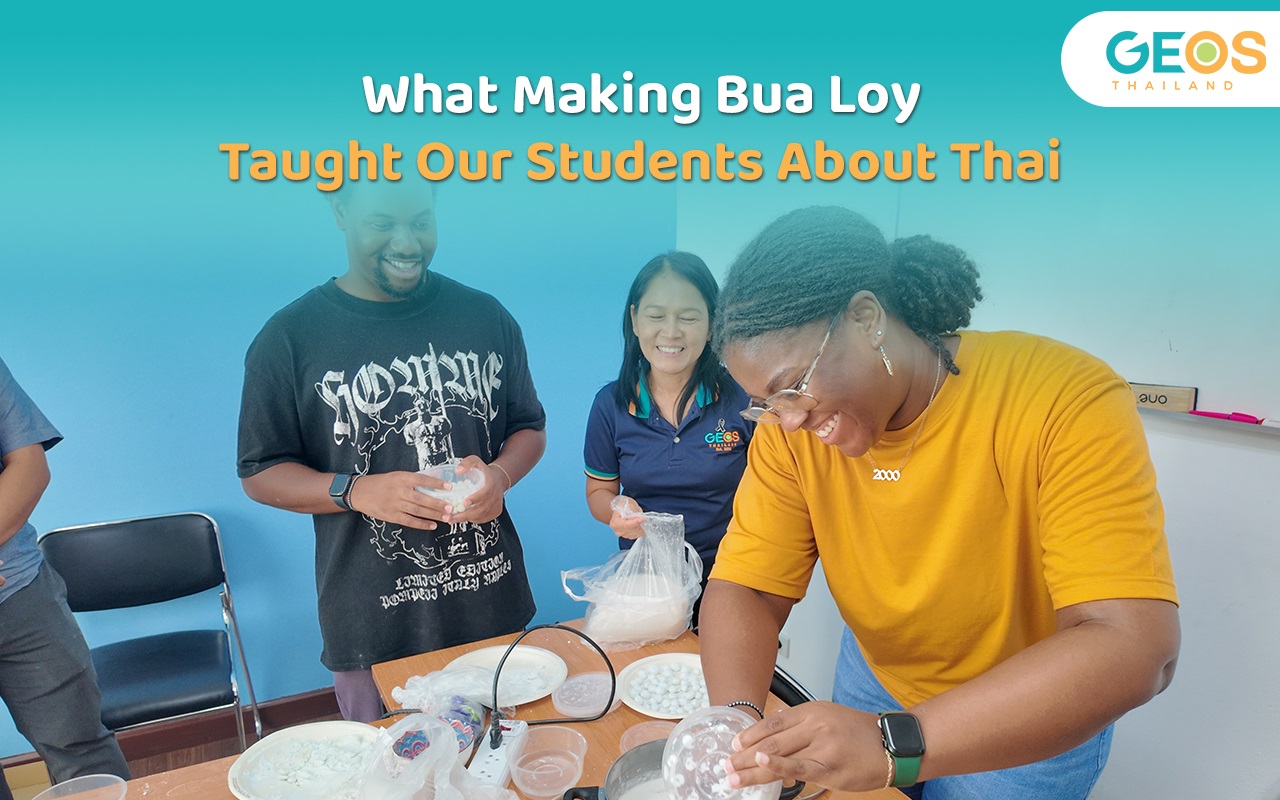
Making Bua Loy from scratch with Thai staff taught GEOS students more useful vocabulary in two hours than a typical classroom session covering the same words on a page. The dessert workshop covered ingredient names, colors, textures, and taste descriptions, all practiced in Thai in a real context rather than a drill. Bua Loy (บัวลอย) means “floating lotus” in Thai, a name that reflects the appearance of the rice flour dumplings as they bob in warm coconut milk. At GEOS, our cultural event program is one of the ways our 20+ years of MOE recognition translates into something students actually feel, not just a credential on a certificate. Food is one of the fastest routes into a language because the vocabulary is immediate, sensory, and memorable. Here is what the workshop looked like, what students learned, and why Thai dessert vocabulary sticks in a way that textbook Thai often does not.
Flour on the table, pandan-green dough in their hands, and a Thai staff member pointing at each ingredient saying its name out loud. Students repeated it back, asked questions in Thai, and described what they were tasting. By the time they were eating, they were using words they had just learned to talk about what they were holding. That is the kind of practice that does not happen at a desk.
Bua Loy is a traditional Thai dessert made from glutinous rice flour dumplings served in warm, sweetened coconut milk. The dumplings are typically colored with natural ingredients: pandan leaf for green, taro for purple, and sometimes butterfly pea flower for blue. The name translates directly as “floating lotus,” which is exactly what the small round dumplings look like as they float in the bowl.
GEOS chose Bua Loy for the annual dessert workshop because it combines a rich vocabulary set with a hands-on process that keeps students engaged. Every stage of making it involves a different set of words: the ingredients, the actions (knead, roll, boil, float), the colors, the textures (soft, chewy, smooth), and the taste descriptions (sweet, rich, fragrant). Students were not just watching. They were doing and speaking at the same time.
For context on how food vocabulary fits into the broader Thai learning journey at GEOS, see our Thai language ED visa document checklist.
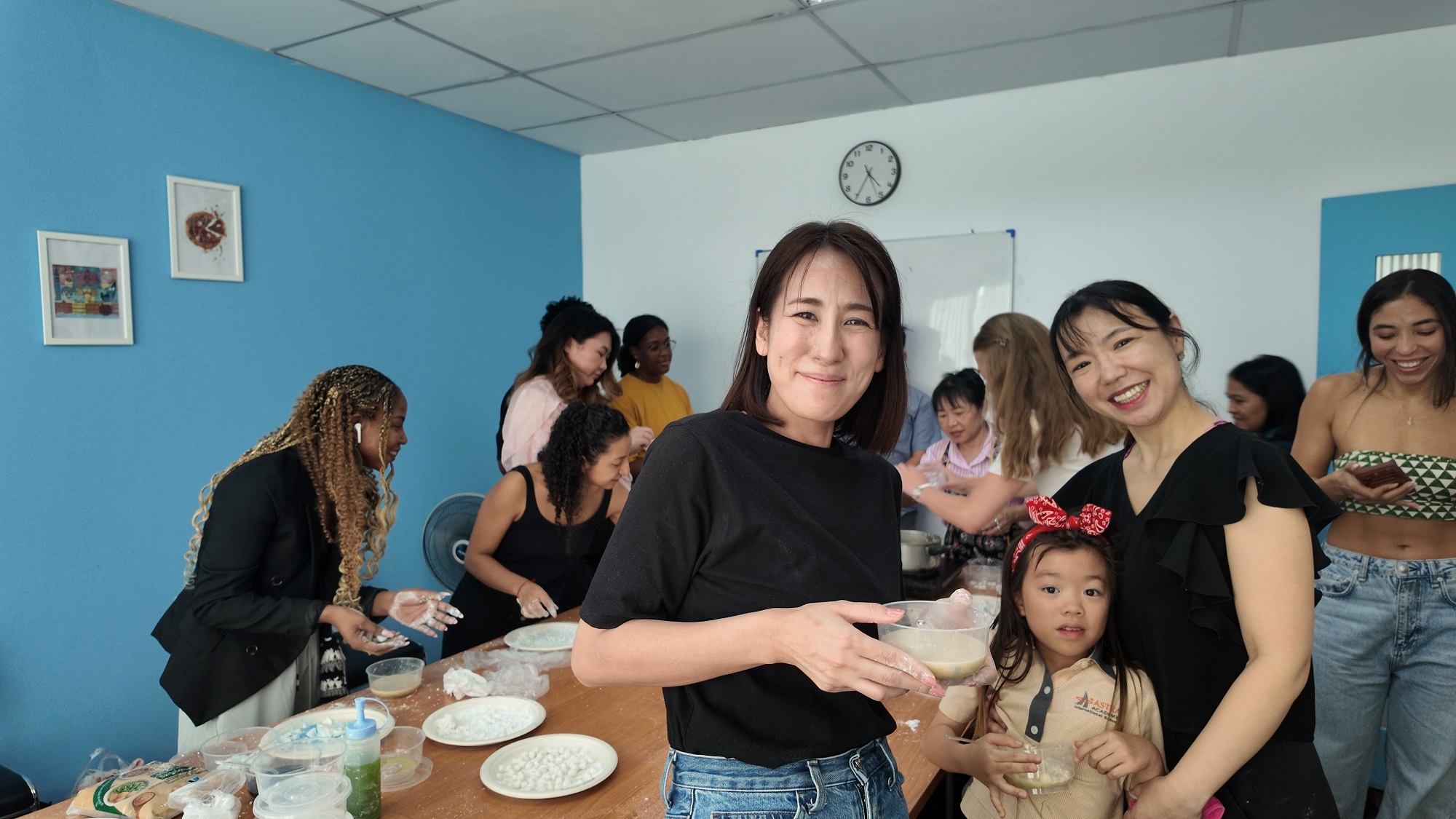
The workshop covered four vocabulary areas; all taught in context rather than from a list:
Thai staff led the session, using Thai throughout and switching to explanation only when students got stuck. The combination of hearing, repeating, doing, and tasting created multiple memory anchors for the same words.
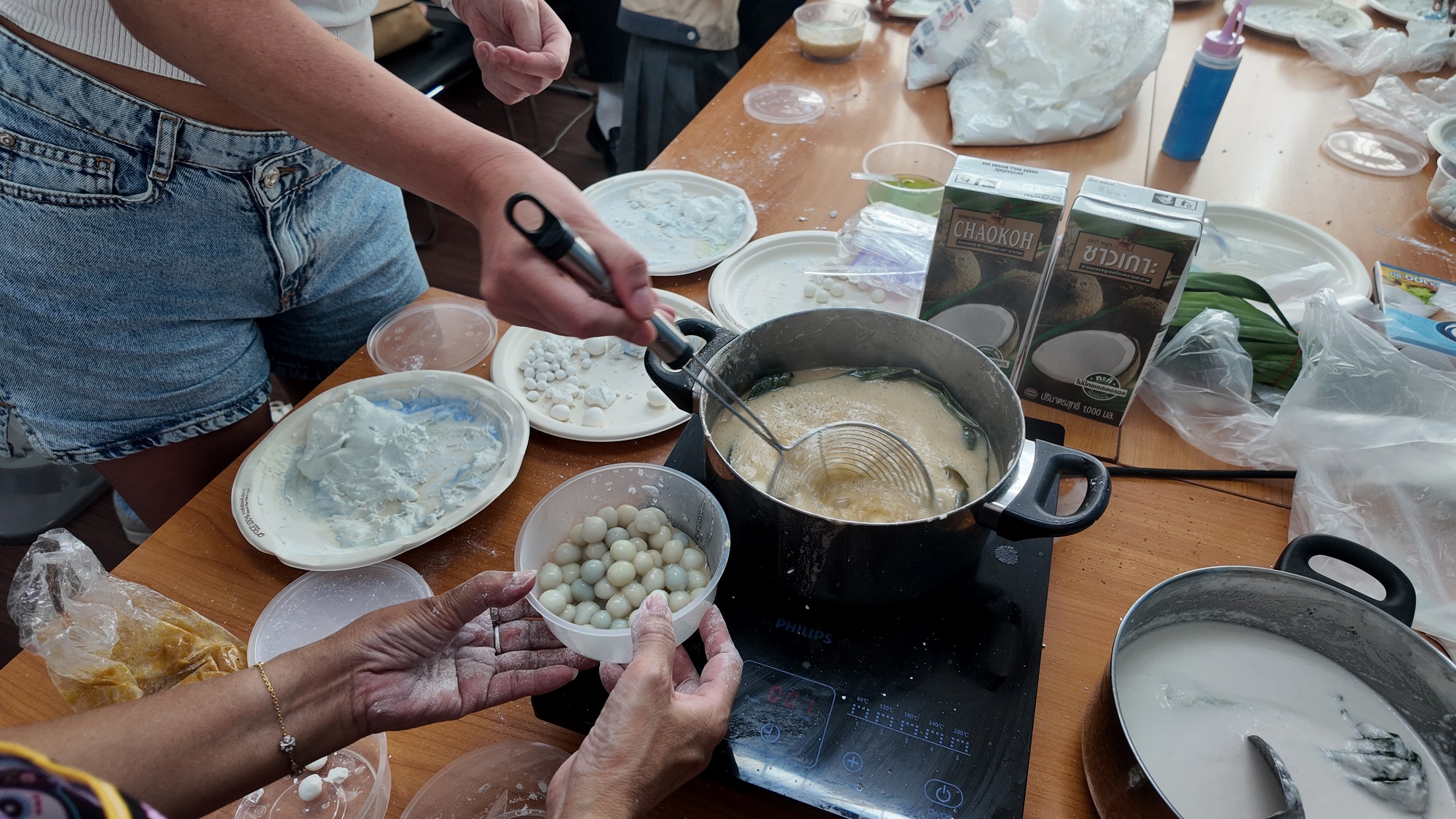
Language retention research consistently shows that words learned in context, especially with a physical or sensory experience attached, stick more reliably than words learned from a list. When a student kneads rice flour dough while saying แป้งข้าวเหนียว out loud, the word becomes linked to a physical memory, not just a page in a notebook.
Food vocabulary in Thai is also immediately useful. Bangkok is one of the world’s great food cities. Students who can describe what they are eating, ask about ingredients, and compliment a cook in Thai find that these phrases open conversations that formal classroom Thai rarely does. Market vendors, restaurant staff, and neighbors respond differently when someone tries, however imperfectly, to describe their food in Thai.
The Tourism Authority of Thailand recognizes Thai cuisine as one of the country’s most significant cultural exports. For GEOS students, engaging with that culture through the language accelerates both language progress and cultural integration.
The Bua Loy workshop is one of approximately four cultural events GEOS runs each year as part of the student experience. Each event is designed to give students a real-world context to practice Thai outside the classroom. The full annual calendar includes:
None of these events are optional add-ons. They are part of how GEOS approaches language learning: the classroom builds the foundation, and the cultural program gives students the reason and the context to use it.
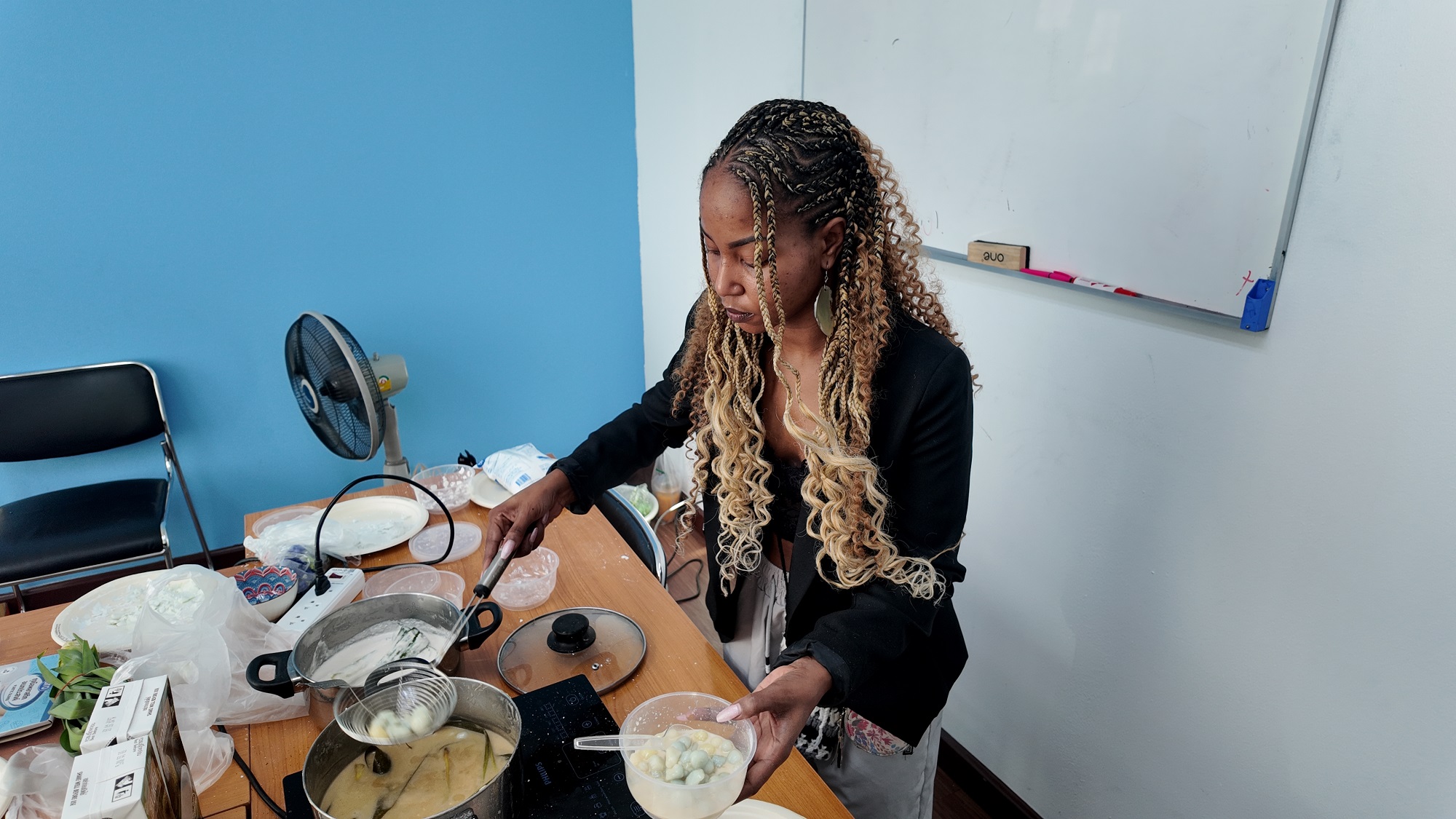
For students who want to try making Bua Loy at home, here is a simple overview of the process as GEOS students experienced it:
The process takes around 45 minutes from start to eating. At the GEOS workshop, students made the dessert in small groups with Thai staff guiding each stage and teaching the vocabulary as they went.
The Bua Loy workshop covered dessert vocabulary specifically. For students building a broader Thai food vocabulary, here are the most useful areas to focus on:
These phrases come up in every market visit, every restaurant order, and every conversation with a Thai cook. Students who learn them in a real context, rather than from a list, use them more confidently and retain them longer.
For guidance on the Thai Royal Institute’s standard romanization of Thai words, see the Royal Society of Thailand, the official authority on the Thai language.
No cooking experience is required. GEOS cultural workshops are designed for language practice first and cooking second. Thai staff guide every step of the process, and the focus is on learning vocabulary and practicing Thai in a real context. Students of all levels and all cooking abilities have joined and found it useful. The most important thing is willingness to try speaking Thai throughout.
Bua Loy is a warm dessert served in coconut milk, which makes it unusual compared to most Thai sweets. It is softer and more delicate than sticky rice-based desserts and has a distinctly floral fragrance from the pandan. For language students, its value is in the vocabulary range it covers: colors, textures, taste descriptions, and ingredient names all come up naturally in the making and eating of it.
Yes, significantly. Food is central to daily life in Bangkok in a way that is hard to overstate. Markets, street stalls, restaurants, and convenience stores are everywhere. Students who can describe what they want, ask about ingredients, and express preference in Thai find that these interactions become genuinely enjoyable rather than stressful. Food vocabulary is also one of the first areas where Thai people notice and appreciate the effort.
GEOS runs approximately four cultural events per year covering food, festivals, and community activities. These include an annual dessert workshop, an annual cooking class, the Loi Krathong festival workshop, and an annual outdoor community gathering. Each event is open to all enrolled students and designed to give real-world context to what students are practicing in class.
Yes. Cultural events at GEOS are part of the student experience and open to all enrolled students at no extra cost. The program is designed to complement classroom learning by giving students real-world opportunities to use Thai outside the lesson. Students do not need to sign up separately. Events are announced to enrolled students at the start of each month.
Indirectly but meaningfully, yes. The ED visa requires genuine study and demonstrable language progress. Students who engage with Thai outside the classroom, through cultural events, market visits, and daily conversations, progress faster and more naturally. That progress shows in assessments and in the confidence, students bring to Immigration appointments. Cultural engagement is not separate from the language program. It is part of what makes it work.
Two hours of making Bua Loy with Thai staff covered more useful, memorable vocabulary than a longer session working through the same words on a page. The names of ingredients, the colors of the dough, the texture of the dumplings, the taste of coconut milk with pandan: every one of those words came with a sensory experience attached. That is what makes them stick.
At GEOS, cultural events like the Bua Loy workshop are built into the student calendar because language learning that only happens inside four walls stops at the door. Bangkok is full of food, markets, festivals, and conversations waiting to happen. We build the program around that. Contact GEOS to find out more about our Thai language program and what a year of studying in Bangkok actually looks like.
Explore our collection of captivating articles, each offering a unique perspective
GEOS Thailand is conveniently located in the heart of Bangkok, close to Asoke BTS and Sukhumvit MRT stations.
enquiry@geosthai.com