
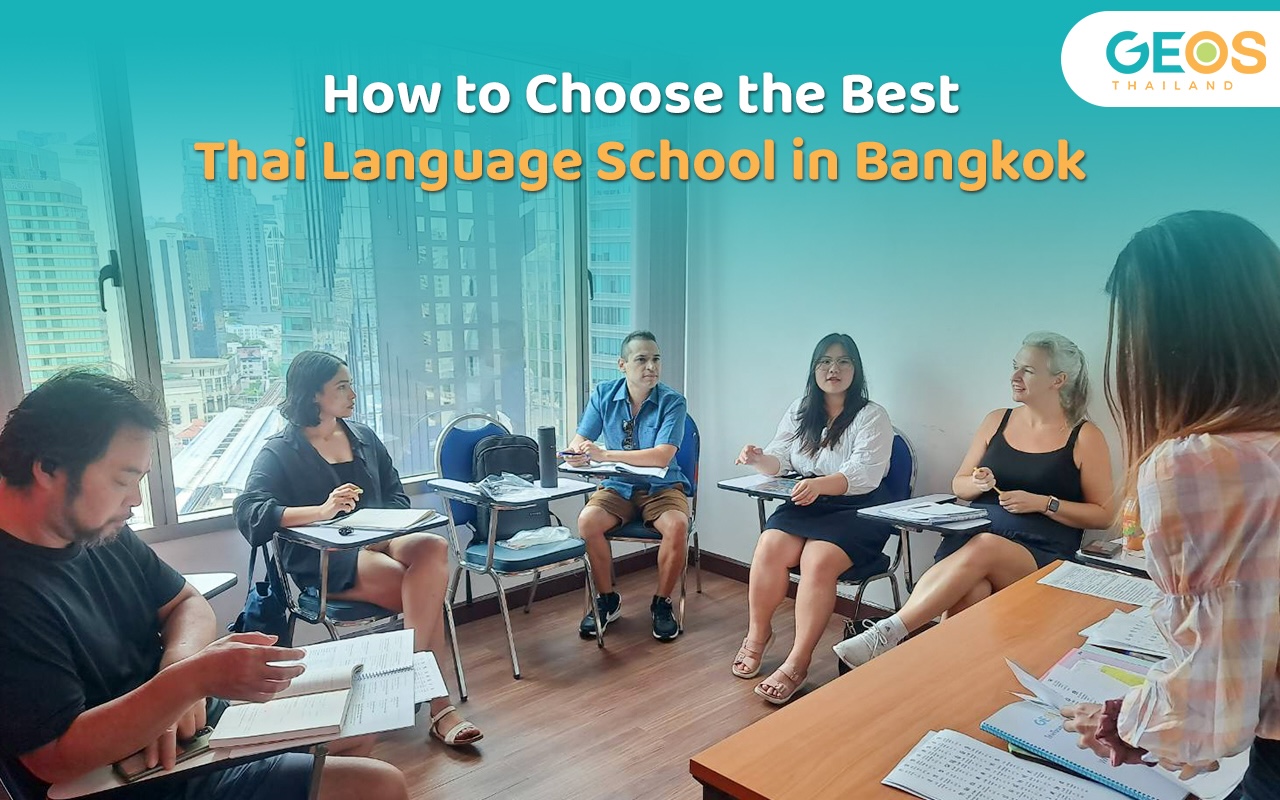
The best Thai language school in Bangkok is one with continuous Ministry of Education recognition, a structured curriculum that builds from beginner to conversational fluency, and genuine support for the ED visa process, not just a signature on a form. Bangkok has dozens of schools claiming to teach Thai, but the differences that actually matter are rarely visible from a homepage. At GEOS, our 20+ years of uninterrupted MOE recognition and a 100% ED visa approval rate for complete applications reflect what happens when a school treats accreditation, curriculum, and visa support as inseparable, not as three separate departments. Six criteria separate a genuinely strong Thai language school from one that simply looks the part: accreditation history, curriculum structure, class size, ED visa handling, teacher quality, and what happens outside the classroom. Every one of these is checkable before you enroll, and every one of them affects how much Thai you actually learn. Here is what to look for, and what a school that gets it right actually does.
Ministry of Education recognition is the legal foundation of an ED visa. Without it, a school cannot issue the acceptance letter that makes an ED visa application possible. But recognition alone is a low bar. What matters more is how long a school has held it without interruption.
Schools with recognition gaps, even brief ones, can create real problems for students partway through a program if the accreditation lapses during enrollment. Ask directly how many consecutive years a school has held MOE recognition, not just whether it currently has it.
GEOS has held continuous MOE recognition for over 20 years. You can verify any school’s accreditation status directly through the Thai Ministry of Education
A strong Thai program should have a clear, structured progression, not a single open-ended course that repeats similar material. Look for a school that can tell you exactly what a student can do at each stage, not just how many hours of class they attend.
At GEOS, the Thai program is structured across four modules: Foundations, Building Fluency, Intermediate, and Advanced Application. Every module has a defined outcome. By the end of Module 1, students can hold basic conversations and read the Thai alphabet. By the end of Module 4, students can navigate extended conversations, read short articles, and write paragraphs. All four skills, speaking, listening, reading, and writing, are taught in every lesson from day one using the Direct Method, meaning Thai is spoken from the first class rather than introduced gradually through translation.
For a full breakdown of what each stage covers and how long it takes, see our Thai language learning timeline
Class size directly affects how much speaking practice each student gets. In the Direct Method, students are expected to speak constantly, answering questions and practicing aloud. A class of 20 students gives each person a fraction of the speaking time compared to a class of 12.
GEOS caps Thai classes at a maximum of 15 students, with most classes considerably smaller in practice. Ask any school directly what their maximum class size is, and ask whether that number is a stated policy or just what happens to be true right now.
This is where the differences between schools become most significant, and where marketing language tends to hide the real answer. Every MOE-recognized school can technically support an ED visa application. What varies enormously is how much of the process the school actually manages for you.
Ask a school these specific questions:
At GEOS, staff accompany every student to their first Chaeng Watthana Immigration appointment. We collect police clearance directly from Royal Thai Police headquarters on Rama 1 Road on the student’s behalf. We maintain a 100% approval rate for students who submit complete applications, a track record built over 20+ years and thousands of visa applications.
For the complete list of documents and what GEOS handles for you, see our Thai language ED visa document checklist. You can also verify Immigration requirements directly at the Thai Immigration Bureau.
Native-speaking teachers are standard across nearly every Bangkok language school, so this alone does not differentiate much. What matters more is whether teachers are trained in a consistent methodology, and whether the school can match students with a teaching style suited to their background.
At GEOS, some Thai teachers speak Japanese, which is a genuine advantage for Japanese nationals learning Thai. Being able to clarify a grammar point in Japanese when the Direct Method alone is not landing accelerates understanding of concepts where Thai and Japanese share structural similarities that English cannot bridge. This kind of teacher matching is rare in Bangkok and worth asking about directly if it applies to you.
For students weighing private lessons against the structured group program, see our comparison: Private vs Group Thai Classes in Bangkok
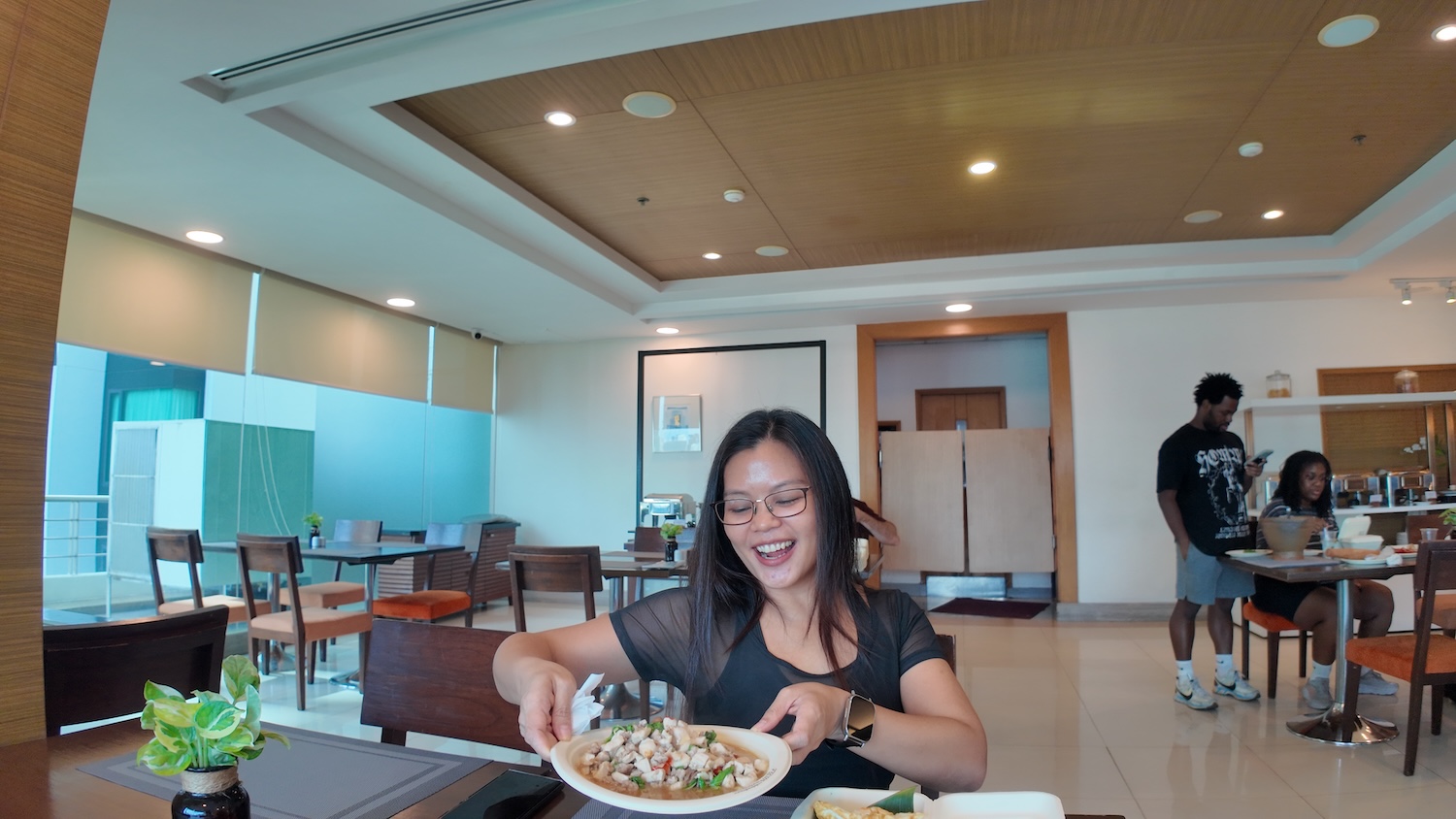
Classroom hours alone rarely produce confident, conversational fluency. The schools that produce the strongest outcomes build structured opportunities to use Thai in real contexts outside class.
GEOS runs a cultural program that includes an annual Thai cooking workshop, an annual Thai dessert workshop, a Loi Krathong festival workshop, and a community outdoor event. These are built into the student calendar specifically because vocabulary learned while cooking, ordering food, or navigating a market sticks in a way that classroom repetition alone does not.
For a full look at how this works in practice, see our post on our recent Bua Loy dessert workshop.
This varies by school. Thailand’s Ministry of Education sets the minimum ED visa age at 13, but many schools, including GEOS, set a higher internal minimum of 15. This is because Immigration officers frequently question ED visa applications from students under 18 at language schools rather than formal educational institutions, which can complicate the process. Confirm the minimum age policy directly with any school before applying.
Costs vary significantly by school and program length. At GEOS, the 14-month Thai program is priced at 55,000 THB total. Always ask whether ED visa processing, police clearance collection, and Immigration accompaniment are included in the quoted price, since these services vary significantly between schools.
No. Most Thai programs in Bangkok, including GEOS, are designed to start from absolute beginner level. A level assessment before enrollment determines your starting point in the curriculum. Students with some prior Thai knowledge are typically placed at a more advanced stage rather than starting from zero, so the assessment matters even if you are not a complete beginner.
Standard processing at GEOS takes 30 to 45 days from enrollment to visa approval. If your nationality requires a criminal background check, allow 50 to 60 days total. Processing timelines vary by school depending on how efficiently documentation is prepared and how closely the school tracks the Ministry of Education approval stage. Ask any school directly what their typical processing time has been for recent students.
It is possible but adds complexity, since your ED visa is tied to your enrolled school. Switching requires the new school to process a fresh MOE application and update your Immigration status accordingly. This is significantly easier to avoid by choosing carefully at the outset. Ask any school about their student retention rate and why students who do leave typically do so.
Not necessarily. School size does not directly correlate with teaching quality, class size, or ED visa support quality. Some larger schools have less personal attention per student and less consistent Immigration support. The six criteria in this guide, MOE recognition history, curriculum structure, class size, ED visa process, teacher matching, and cultural program, matter more than overall school size when making this decision.
The strongest indicator of a good Thai language school is not a claim on a website. It is a track record you can check: how many years of continuous MOE recognition, how structured the curriculum actually is, how small the classes really are, and how much of the ED visa process the school genuinely manages rather than simply pointing you toward.
At GEOS, every one of these six criteria is something we can show, not just tell you. 20+ years of MOE recognition. A four-module curriculum with defined outcomes at each stage. A maximum class size of 15. Staff accompaniment to your first Immigration appointment. Police clearance collected on your behalf. A cultural program built into the student calendar, not sold separately. Contact GEOS to discuss your Thai language goals, and we will walk you through exactly how each of these works before you enroll.
Explore our collection of captivating articles, each offering a unique perspective
GEOS Thailand is conveniently located in the heart of Bangkok, close to Asoke BTS and Sukhumvit MRT stations.
enquiry@geosthai.com