

A Thai ED visa is worth it if you want to live in Bangkok for 12 to 15 months, study a language seriously, and build a real life in Thailand — not just pass through. It gives you a legal long-term stay, a structured study program, and the time to actually settle in. It is not worth it if you plan to travel frequently around Asia, or if you are not committed to attending classes. At GEOS, our 20+ years of Ministry of Education (MOE) recognition and 100% approval rate for complete applications mean we tell prospective students honestly when an ED visa is not the right fit for them. The ED visa is one of the most accessible long-term visa options Thailand offers, and for the right person, it genuinely changes how they experience the country. Here is the honest answer.

The ED visa is a non-immigrant visa issued to students enrolled at a
Ministry of Education-recognized language school. In practical terms, it gives you:
What the ED visa does not give you is the freedom to use Thailand as a base while you travel in Southeast Asia. The visa is for students who intend to study. Immigration officers assess visa extensions based on your attendance and demonstrable progress — if you are not in class, your extension is at risk.
For a full breakdown of the application process, see the ED visa study guide.
Two clear cases where an ED visa is not the right choice:
The ED visa is designed for students who live in Thailand and study. If you plan to leave Thailand regularly — weekend trips to Vietnam, a month in Japan, hopping between countries — immigration will question whether you are genuinely enrolled. Frequent border crossings raise red flags. If travel flexibility is important to you, the Destination Thailand Visa (DTV) or a tourist visa extension route is a better fit.
At GEOS, Thai and Japanese students study 8 hours per week during the beginner and intermediate stages, followed by 6 hours per week during the advanced stage. English ED visa students study 6 hours per week. For the Thai program, immigration assesses whether students can demonstrate language progress when extensions are reviewed. If you are paying for an ED visa but not attending class, you are wasting money and taking a risk. Immigration can and does decline extensions when attendance and progress are not evident. The ED visa is not a residency workaround — it is an education visa, and it works best for people who treat it as one.
Most GEOS students arrive alone. They do not know anyone in Bangkok. They speak limited or no Thai. And within a few months, something shifts.
The language is part of it. A student who arrives unable to order food in Thai and leaves 14 months later navigating markets, making friends with neighbors, and reading street signs is not an unusual outcome. That kind of progress does not happen on a tourist visa with weekend classes. It happens when you live somewhere, commit to learning, and give yourself the time.
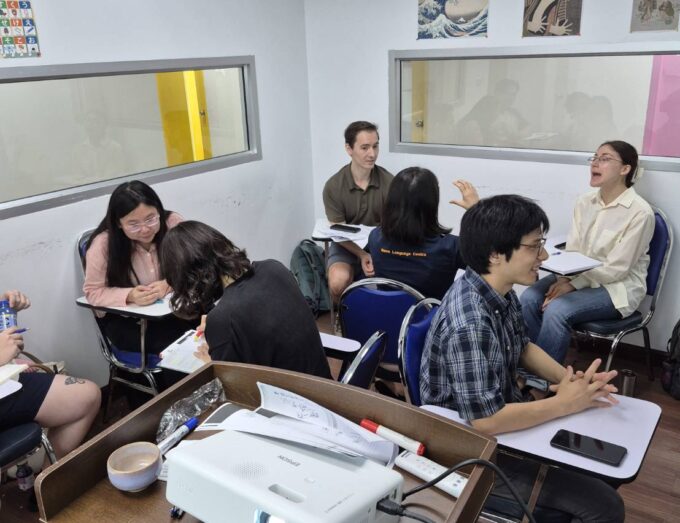
The community is the other part. GEOS has students from over 40 nationalities, typically between 18 and 45 years old. The school runs cultural events and brings students together in ways that make Bangkok feel less foreign and more like home. For students arriving solo — and most do — this matters more than any visa benefit.
GEOS also runs community events at the school and helps students integrate into Bangkok life in practical ways. Students who feel connected to where they are learning tend to progress faster and stay longer. That is not a coincidence.

For many students, the ED visa is not the final destination — it is the starting point.
The retirement visa route
Thailand’s retirement visa (Non-Immigrant O-A) requires a minimum of 800,000 THB in a Thai bank account or a monthly income of 65,000 THB. For people approaching retirement who want to try living in Thailand before committing to those requirements, the ED visa is a low-barrier way to do a genuine trial run. Study Thai, English, or Japanese, build a life in Bangkok, and decide if long-term retirement here is right — without locking up a large sum in a Thai bank account first. Several GEOS students have moved directly from an ED visa to a retirement visa after completing their program.
The DTV route
The DTV suits remote workers and people who want to spend extended time in Thailand with the flexibility to travel. After completing an ED visa program at GEOS, students who want that travel flexibility have a natural transition path to the DTV. A year of living in Bangkok, building local knowledge, establishing a residential history, and understanding how Thailand works is excellent preparation for making the most of a DTV.
The language foundation
Beyond visas, students who complete a Thai language program leave with something that no other long-term visa provides: the ability to communicate with the country they are living in. That changes every subsequent year they spend in Thailand, regardless of what visa they hold.
Most language schools enroll you and leave you to figure out Bangkok on your own. GEOS does not.
From the day a student enrolls, GEOS helps with:
For a 17-year-old arriving in Bangkok from South America with no contacts, no Thai, and a family watching from thousands of kilometers away, having a school that handles more than the classroom is not a convenience — it is the difference between a successful year and a difficult one. GEOS has students in exactly that situation, and taking care of them is part of what we do.
For students needing accommodation, see our real estate support page or contact GEOS to start the process.
The honest financial comparison matters. Consider what staying in Thailand for 12 months looks like without an ED visa:
The ED visa at GEOS eliminates all of that. One application, handled by GEOS, has a 100% approval rate for complete submissions. Extensions processed at Chaeng Watthana Immigration every few months. No border runs for the English program. No immigration anxiety. The program cost is the cost — there are no hidden fees, no surcharges on immigration payments, and no agent fees on top.
For details on proof of funds and what is actually required financially, see our post: Do You Need Proof of Funds for a Thai ED Visa?
No. The ED visa is a student visa. It does not permit employment in Thailand. If you are working remotely for a company outside Thailand, that is a different matter — but officially earning income from Thai sources or holding a Thai work contract is not permitted on an ED visa.
Poor attendance puts your visa extension at risk. Immigration assesses extensions based on your student status, and schools are expected to demonstrate that you are genuinely studying.
Yes, but you need a re-entry permit before you leave. Departing Thailand without one cancels your ED visa. Single re-entry permits cost 1,000 THB, and multiple re-entry permits cost 3,800 THB. If you plan to travel occasionally during your program, apply for a multiple-entry permit. Frequent travel will draw attention from immigration at the extension time.
For people who qualify — students genuinely enrolled at an MOE-recognized school — the ED visa is one of the most straightforward long-term visas Thailand offers. There is no minimum bank balance requirement, no income threshold, and no age limit. GEOS’s 100% approval rate for complete applications reflects how manageable the process is when documentation is handled correctly.
Most GEOS students are between 18 and 45, though the school has enrolled students from 15 to their late 60s. Younger students benefit from the community and practical support GEOS provides. Older students — particularly those exploring Bangkok before committing to a retirement visa — find the program gives them a genuine trial of long-term life in Thailand before making larger financial commitments.
Contact GEOS before you decide. We will ask about your plans, your nationality, how long you want to stay, whether you need to travel, and what you want to get out of your time in Bangkok. If the ED visa is not the right fit, we will tell you — and suggest what is. After 20+ years of processing ED visas, we know who the program works for and who it does not.
The ED visa is worth it for someone who wants to live in Bangkok, commit to learning a language, and give themselves the time to actually do it properly. It is not worth it for someone treating Thailand as a travel base or treating class attendance as optional.
At GEOS, we have watched students arrive alone, unable to communicate, unsure whether they made the right decision — and leave 12 to 15 months later with language skills, real friendships, and a clear picture of what life in Thailand looks like for them. Some go on to a retirement visa. Some transition to a DTV. Some simply go home with something they could not have built any other way. That outcome is what the ED visa, done properly, actually produces. Contact GEOS to find out if it is the right choice for you.
Explore our collection of captivating articles, each offering a unique perspective
GEOS Thailand is conveniently located in the heart of Bangkok, close to Asoke BTS and Sukhumvit MRT stations.
enquiry@geosthai.com